
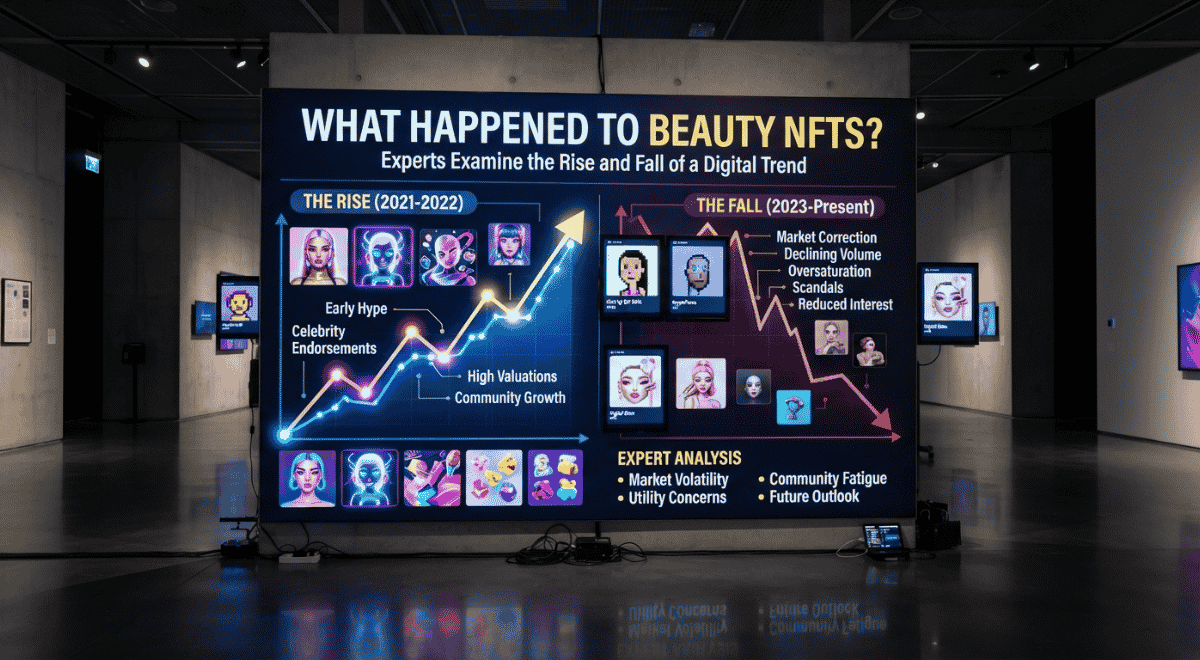
When non-fungible tokens (NFTs) surged into the mainstream several years ago, the beauty industry was quick to explore their potential. Digital collectibles, virtual products and blockchain-powered experiences were promoted as new ways for consumers to interact with beauty brands beyond traditional physical products.
Major names across the sector, including NARS Cosmetics, L’Oréal and YSL Beauty, experimented with NFTs as brands looked to connect beauty with emerging technologies and digital communities.
For a brief period, NFTs appeared to represent more than another cryptocurrency-driven trend. They were viewed as a possible new frontier for beauty marketing, offering brands opportunities to create digital ownership, exclusivity and online experiences.
However, the excitement surrounding NFTs has since faded considerably.
As the wider NFT market cooled, consumer interest declined, leaving many of the beauty industry’s early experiments largely behind the scenes. This has raised an important question: were beauty NFTs simply introduced too early, or was there never a strong enough connection between blockchain-based ownership and the way consumers experience beauty?
Industry experts now point to several reasons why the concept struggled to develop into a mainstream beauty category.
Beauty and NFTs Had Limited Natural Synergy
According to freelance beauty editor and industry expert Julia Wray, the beauty sector has always needed to explore emerging technologies and marketing channels. The challenge, however, is determining whether a new platform will genuinely transform consumer behaviour or simply become another short-lived trend.
Wray argues that NFTs ultimately followed the latter path.
She believes there was never a particularly strong natural connection between NFTs and beauty compared with other industries. Instead, large beauty groups and luxury companies saw blockchain technology as an experimental opportunity and were willing to test whether it could become commercially relevant.
The high cost associated with blockchain platforms such as Ethereum also limited accessibility during the NFT boom. As a result, NFT experimentation was largely concentrated among major, financially powerful beauty companies rather than becoming a widespread strategy across the industry.
The Problem With Digital Ownership in Beauty
One of the biggest challenges was the physical nature of beauty itself.
Unlike industries where digital ownership can directly enhance the consumer experience, beauty relies heavily on sensory interaction. Consumers want to see, smell, touch and apply products, or watch someone demonstrate how they work.
That creates a fundamental challenge for NFTs.
Why would a beauty consumer spend an amount comparable to the cost of a physical beauty product on a digital collectible that cannot provide the same sensory experience?
NFTs could offer exclusivity and a sense of digital ownership, but those benefits were not necessarily enough to justify the cost for the average beauty shopper.
Scarcity and Community Still Matter
That does not mean every principle behind NFTs was irrelevant to beauty.
Beauty brands have long relied on limited-edition products, exclusive launches, merchandise and community-building to create excitement. Scarcity can encourage consumers to act quickly, while belonging to a particular community can strengthen loyalty to a brand.
NFTs were capable of combining both ideas.
The problem was that the technology itself often became the focus rather than the consumer experience. For beauty brands, simply attaching blockchain technology to a digital collectible did not automatically create meaningful value.
The strongest beauty campaigns tend to give consumers a reason to participate, whether through exclusive products, experiences, access or a genuine connection with a community.
NFTs struggled to consistently deliver that value at scale.
Why the NFT Moment Faded
The decline of beauty NFTs reflects a wider shift in the digital market. The initial excitement around NFTs was driven partly by speculation, celebrity involvement and the perception that digital assets could rapidly increase in value.
As that enthusiasm weakened, consumers became more selective about what they were actually receiving in exchange for their money.
For beauty brands, this exposed a major weakness in the model. A digital collectible alone was rarely enough to maintain long-term engagement.
The industry also had to contend with rapidly changing consumer platforms. Social media networks and short-form video offered beauty companies more immediate ways to demonstrate products, build communities and drive purchases.
Compared with those channels, NFTs could appear complicated, expensive and disconnected from everyday beauty consumption.
A Lesson for Beauty’s Next Digital Experiment
The experience of NFTs does not necessarily mean beauty brands should abandon emerging technology.
Instead, it highlights the importance of putting consumer value ahead of technological novelty.
The beauty industry has repeatedly demonstrated that consumers are willing to embrace digital experiences when they solve a problem, provide entertainment or offer something genuinely exclusive. The challenge is making sure the technology supports that experience rather than becoming the product itself.
NFTs may therefore be remembered less as a failed beauty category and more as an early experiment that showed brands what consumers were—and were not—willing to pay for in the digital world.
The concept of digital ownership may not disappear completely. But for beauty brands, the future is likely to depend on creating meaningful experiences that combine digital engagement with the physical, sensory and community-driven qualities that make beauty such a distinctive category.