
NFTs have moved far beyond their early reputation as speculative digital collectibles. In 2026, they are increasingly being treated as core digital infrastructure—supporting use cases in gaming ecosystems, tokenized real-world assets (RWAs), digital identity systems, and brand loyalty programs. This shift from hype to utility is quietly reshaping how startups and enterprises approach the NFT economy.
At the center of this evolution are NFT marketplaces. These platforms are no longer just trading hubs; they function as transactional layers that enable discovery, ownership, and exchange of tokenized assets across Web3 ecosystems. From gaming studios launching in-game items to brands issuing digital collectibles, NFT marketplaces have become a foundational entry point into blockchain-based business models.
However, building an NFT marketplace from scratch remains complex. It requires deep expertise in smart contracts, blockchain integration, cybersecurity, backend architecture, and UI/UX design. For many startups, this creates a high barrier to entry in both time and cost.
As a result, many businesses are turning to NFT marketplace clone scripts as a faster and more practical alternative.
What is an NFT Marketplace Clone Script?
An NFT marketplace clone script is a pre-built software framework designed to replicate the core functionality of an NFT trading platform. This typically includes features such as:
- NFT minting
- Listing and trading
- Auction systems
- Wallet integration
- User dashboards
Instead of building every component from scratch, businesses can deploy a ready-made architecture and customize it based on their brand and use case.
In simple terms, it serves as a foundation that significantly reduces development time while allowing flexibility in design and feature enhancement.
While custom development offers full control, it requires significant resources. Clone scripts, on the other hand, strike a balance between speed, cost-efficiency, and customization—making them especially attractive for startups validating new ideas.
Top NFT Marketplace Clone Script Providers in 2026
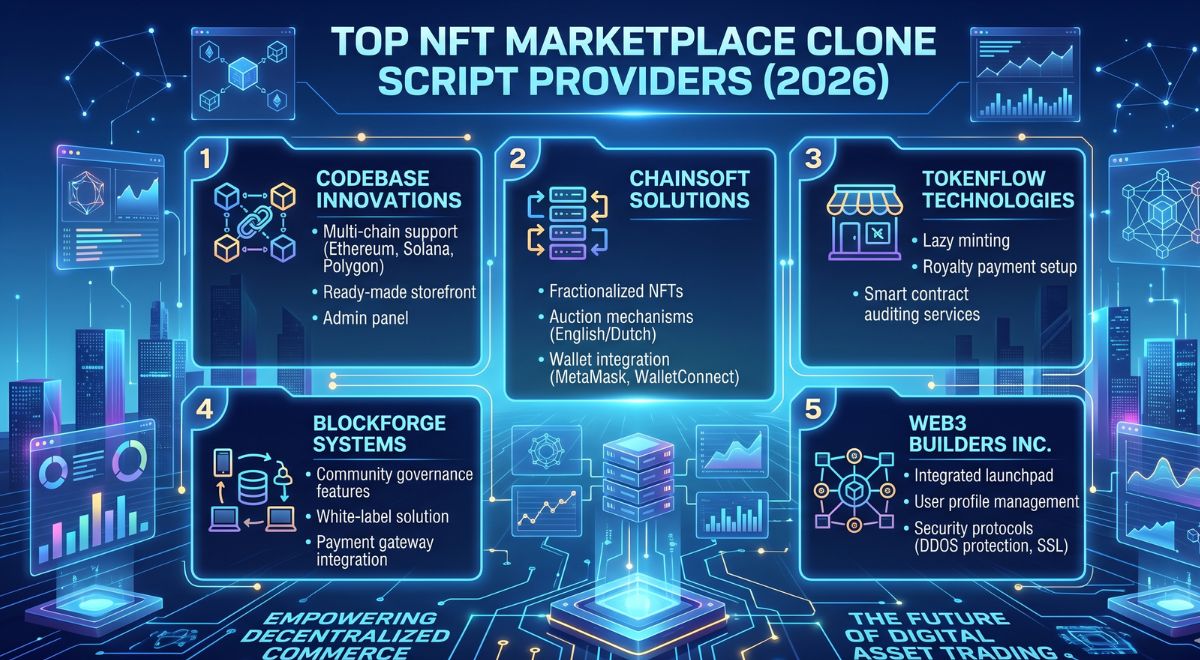
Several companies now offer NFT marketplace clone solutions based on established platforms like OpenSea, Rarible, and others. Below are some of the most recognized providers in the market.
1. Coinsclone
Coinsclone focuses on modular blockchain development solutions, including NFT marketplace scripts designed for fast deployment. Their systems are built to support multiple blockchain networks and allow feature-level customization, making them suitable for startups aiming to launch quickly and iterate.
2. Pixel Web Solutions
Pixel Web Solutions emphasizes design flexibility alongside core NFT functionality. Their clone scripts combine trading features with UI/UX customization, allowing businesses to build visually distinctive marketplaces with multi-chain support.
3. Rain InfoTech
Rain InfoTech offers end-to-end blockchain development services, including NFT marketplace clone scripts. Their approach focuses on full-cycle development—from concept to deployment—with strong customization capabilities.
4. SuffesCom Solutions
SuffesCom Solutions provides a broad portfolio of white-label blockchain products, including NFT marketplace frameworks. Their solutions are designed for businesses exploring multiple Web3 applications under one development ecosystem.
5. iMetaTech
iMetaTech specializes in NFT and metaverse-oriented platforms. Their marketplace solutions are often integrated with immersive digital environments, making them suitable for gaming and virtual ecosystem projects.
6. Debut Infotech
Debut Infotech focuses on enterprise-grade blockchain development. Their NFT marketplace solutions prioritize scalability, performance, and long-term architecture for complex business use cases.
7. ChainTechSource
ChainTechSource delivers ready-to-deploy NFT marketplace scripts with essential trading features such as auctions, minting, and wallet integrations. Their offerings are designed for practical and fast implementation.
8. NetSet Software
NetSet Software takes a consulting-driven approach, combining strategy with technical development. Their NFT marketplace solutions are tailored to align closely with business models and long-term goals.
9. Bitrix Infotech
Bitrix Infotech provides execution-focused NFT marketplace scripts designed for rapid deployment. Their solutions prioritize simplicity and faster go-to-market timelines.
10. Innow8apps
Innow8apps delivers feature-rich NFT marketplace solutions with modular configurations. Their platforms support multiple blockchain networks and are designed for usability and scalability.
Why Businesses Are Choosing Clone Scripts
NFT marketplace clone scripts have become popular not just because they are cheaper, but because they align with how modern Web3 products are built.
Faster Time to Market
Startups can launch in weeks instead of months, allowing them to test real user demand quickly.
Lower Development Costs
Clone scripts eliminate the need for large in-house blockchain teams in early stages.
Proven Architecture
Most scripts are modeled after successful marketplaces, meaning core workflows are already validated.
Flexible Customization
Modern solutions allow modifications in UI, features, and blockchain integration layers.
How to Choose the Right Provider
Selecting the right provider depends less on feature lists and more on strategic alignment. Key factors include:
- Use case clarity: gaming, collectibles, RWAs, or brand assets
- Customization depth: UI flexibility vs core smart contract control
- Scalability: ability to handle long-term user growth
- Support and maintenance: post-launch technical assistance
- Long-term independence: avoiding vendor lock-in
In most cases, the best provider is not the one offering the most features, but the one that best aligns with your product roadmap and growth strategy.
Final Perspective
NFT marketplaces are evolving into essential infrastructure within Web3 ecosystems. As their role expands into gaming, digital identity, and tokenized economies, demand for faster deployment solutions continues to grow.
NFT marketplace clone scripts are not just shortcuts—they are acceleration tools. They allow businesses to validate ideas quickly, reduce technical friction, and scale based on real market feedback.
In a rapidly evolving digital economy, the ability to launch fast and adapt continuously is becoming just as important as the technology itself.