
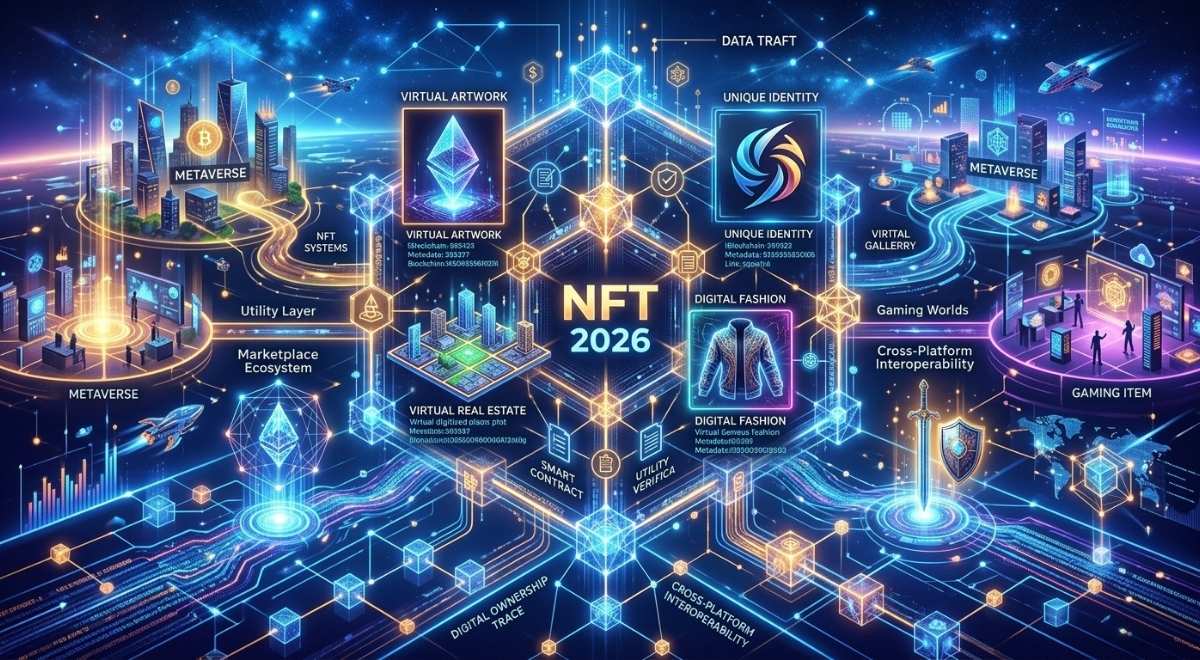
The claim that NFTs died in 2023 makes for an easy headline, but it oversimplifies what actually happened.
The speculative market for profile-picture collectibles suffered a dramatic collapse after the 2021–22 boom, with some collections losing 90% or more of their value. But the underlying technology never disappeared. Instead, NFTs have gradually moved away from celebrity-driven digital art and toward applications involving tickets, gaming assets, credentials, ownership records and real-world assets.
NFT trading activity also shows that the market did not vanish. Monthly trading volumes reached an annual high of about $546 million in October 2025, alongside 10.1 million individual sales. While those numbers remain far below the speculative peaks of 2021, they indicate that demand for blockchain-based unique assets continues.
The bigger change is in who uses NFTs and what they use them for.
A buyer spending hundreds of thousands of dollars on a cartoon ape attracted enormous attention during the NFT boom. An event organizer issuing tens of thousands of blockchain-based tickets in 2026 is considerably less exciting, but potentially far more useful.
That shift from speculation to utility is central to understanding why NFTs still matter.
What exactly is an NFT?
NFT stands for non-fungible token.
“Fungible” means that individual units are interchangeable. One bitcoin, for example, is functionally equivalent to another bitcoin of the same amount. NFTs work differently because each token has a unique identifier that distinguishes it from other tokens.
An NFT is essentially a blockchain-based record associated with a unique digital or physical asset. The blockchain records ownership and transfers, while additional metadata can describe the asset represented by the token.
On Ethereum, two important token standards are ERC-721 and ERC-1155.
ERC-721 was designed for individually identifiable tokens, with each token carrying a unique ID. ERC-1155, meanwhile, allows a single smart contract to manage multiple types of assets. A game developer could use it to issue thousands of identical items alongside a limited number of unique weapons, for example.
The distinction is important because NFTs are not limited to artwork. The same underlying technology can be used to represent tickets, gaming items, memberships, certificates and other unique assets.
The NFT itself usually isn’t the image
One of the most misunderstood aspects of NFTs is where the actual digital artwork or media is stored.
The NFT generally does not contain the image, video or other large file directly on the blockchain. Instead, the token usually contains or points to metadata, which can include a link to the associated media.
That media may be hosted using decentralized storage networks such as IPFS or Arweave. Other projects rely on conventional centralized servers.
This creates an important distinction: the blockchain record can survive even if the file associated with it disappears.
If an NFT points to a centralized server that eventually goes offline, the token can remain on the blockchain while its associated image becomes inaccessible. Decentralized or permanent storage can reduce that risk.
How are NFTs created?
Creating an NFT is commonly referred to as minting.
A creator uses an existing smart contract or deploys a new one and creates a token with a unique identifier. Once the transaction is confirmed, the token exists on the blockchain and can be transferred between compatible wallets.
The blockchain records subsequent transactions, creating a publicly verifiable ownership history.
To hold and transfer NFTs, users generally need a compatible cryptocurrency wallet. Modern wallets and account-abstraction systems have made this process easier, although blockchain onboarding still presents challenges for newcomers.
NFTs existed long before the 2021 boom
NFTs did not begin with CryptoPunks or Bored Ape Yacht Club.
Experiments with unique digital assets on blockchain networks date back to the early 2010s. Colored Coins explored ways to attach additional information to Bitcoin units, while Counterparty later enabled the creation of custom assets on Bitcoin.
Rare Pepes, introduced in 2016, became an early example of blockchain-based digital collectibles with an active secondary market.
Then came CryptoPunks in 2017. The project introduced 10,000 algorithmically generated pixel characters on Ethereum. Because ERC-721 did not yet exist, CryptoPunks used a custom contract design.
Later that year, CryptoKitties demonstrated another important feature of blockchain collectibles. Users could buy, sell and breed digital cats, generating enough activity to contribute to significant congestion on the Ethereum network.
The incident was a warning about blockchain scalability, but it also demonstrated that people were willing to transact over unique digital assets.
The mainstream breakthrough
NFTs reached a much larger audience in 2020 and 2021.
NBA Top Shot introduced blockchain-based digital collectibles to mainstream sports fans, allowing users to collect licensed video highlights known as “Moments.”
The market then exploded in early 2021.
In March of that year, digital artist Beeple sold Everydays: The First 5000 Days through Christie’s for $69.3 million. The sale became one of the defining moments of the NFT boom.
Trading activity surged, celebrities launched collections and major brands entered the market. Nike, Adidas, Gucci and numerous other companies experimented with blockchain-based collectibles and virtual products.
OpenSea’s monthly trading volume eventually climbed into the billions of dollars.
For a period, NFTs became synonymous with digital speculation.
The crash changed the market
The boom did not last.
As cryptocurrency markets weakened in 2022 and 2023, NFT prices followed. Many profile-picture collections experienced enormous declines in floor prices, while some projects abandoned promised roadmaps or struggled to maintain communities.
Marketplaces also faced pressure. OpenSea cut staff, while competitors such as Blur adopted models designed more heavily around professional traders and trading incentives.
The collapse led many observers to conclude that NFTs were simply a passing trend.
But developers continued building.
Magic Eden expanded beyond its original Solana focus, while marketplaces increasingly supported multiple blockchain ecosystems. Infrastructure also improved as layer-2 networks reduced transaction costs and blockchain wallets became easier to use.
The result is an NFT market that looks very different from the one that dominated headlines in 2021.
Where NFTs stand in 2026
By 2026, NFTs are increasingly being evaluated according to their utility rather than their novelty.
Industry estimates put the global NFT market at tens of billions of dollars, with gaming, digital assets and real-world applications accounting for significant activity.
Gaming is one of the most important areas.
Developers can represent characters, weapons, skins, land and other digital items as blockchain tokens. In theory, this can give players verifiable ownership and allow assets to be traded outside the original game ecosystem.
True cross-game interoperability remains limited, however. Simply putting an item on a blockchain does not mean another game will automatically support it.
The technology is therefore still evolving rather than delivering the fully interoperable gaming economy once promised by NFT advocates.
NFTs in gaming
Gaming is one of the clearest examples of NFTs moving beyond digital artwork.
A blockchain-based game can give players ownership of individual items and allow those items to be transferred or sold through secondary markets.
Networks such as Immutable and Polygon have attracted gaming developers, while major publishers have experimented with blockchain technology.
The appeal is straightforward: instead of having an item exist only inside a company’s database, a blockchain can create an independently verifiable ownership record.
The challenge is equally straightforward. Players generally care more about whether an item makes a game enjoyable than whether it exists on a blockchain.
For NFTs to succeed in gaming, the technology needs to provide practical benefits without adding unnecessary complexity.
Real-world assets and digital twins
Another emerging use case is connecting physical assets to blockchain tokens.
Luxury watches, artwork, collectibles and other high-value goods can be paired with digital certificates that record authenticity or ownership.
A blockchain token can potentially follow an asset through multiple transactions, providing buyers with a persistent provenance record.
Real estate and financial assets are also being explored through tokenization, although these applications often involve regulatory and legal structures that are considerably more complex than conventional NFT collectibles.
This area could ultimately prove more significant than profile-picture collections because it connects blockchain technology with established markets.
NFT ticketing
Ticketing is another practical application.
Blockchain-based tickets can provide verifiable records that make counterfeit tickets harder to create. Smart contracts can also be programmed with rules governing transfers, resale or access to additional benefits.
Organizers could, for example, issue a digital ticket that provides event access and later unlocks merchandise, membership benefits or other experiences.
Platforms such as GET Protocol and YellowHeart have experimented with blockchain-based ticketing.
The major advantage is not that a ticket becomes an “NFT.” It is that the underlying technology can create a programmable and verifiable digital ticket.
Identity and credentials
NFT technology is also being explored for digital credentials.
Soulbound tokens, a concept discussed by Ethereum co-founder Vitalik Buterin and other researchers, are designed to be non-transferable. This makes them potentially useful for representing credentials that should remain tied to a particular identity.
Potential applications include:
- Academic diplomas
- Professional certifications
- Membership credentials
- Training records
- Event badges
The concept remains under development, and privacy is an important consideration. Not every credential should necessarily be permanently visible on a public blockchain.
Music and creator economics
NFTs have also offered musicians an alternative way to monetize audiences.
Artists can sell limited digital editions, memberships or rights linked to music-related assets. Some platforms have experimented with distributing revenue or royalties to token holders.
The broader idea is to give creators more direct relationships with their audiences.
Instead of relying exclusively on advertising, streaming payments or traditional intermediaries, artists can sell limited digital assets directly to fans.
Whether this model becomes mainstream remains uncertain, but the experiment represents one of the more interesting applications of tokenized ownership.
Token-bound accounts make NFTs more powerful
A significant technical development has been the emergence of token-bound accounts, associated with Ethereum’s ERC-6551 standard.
The concept allows an NFT to control assets of its own.
For example, a blockchain-based game character could own weapons, clothing and other items. If the character itself is sold, its associated inventory could move with it.
This creates a more composable form of digital ownership.
Instead of an NFT being simply a certificate pointing toward an image, it can potentially become an on-chain container capable of interacting with other assets and applications.
Has the environmental criticism disappeared?
Environmental concerns were a major part of the NFT debate during the 2021 boom.
At that time, Ethereum used proof-of-work mining, which required significant computing resources. That changed in September 2022 when Ethereum completed The Merge and transitioned to proof of stake.
Ethereum’s energy consumption subsequently fell dramatically, with estimates putting the reduction at more than 99%.
Many NFTs are now issued on proof-of-stake networks such as Ethereum, Polygon and Solana, meaning the environmental argument surrounding NFTs is very different from the one made during the 2021 boom.
That does not mean blockchain technology has no environmental footprint. Data centers, networking equipment and consumer devices still require energy.
Bitcoin-based inscriptions and Ordinals also remain linked to Bitcoin’s proof-of-work network.
However, the argument that every NFT transaction inherently requires the enormous energy consumption associated with proof-of-work mining is no longer an accurate description of most NFT activity.
Owning an NFT does not necessarily mean owning copyright
One of the biggest legal misconceptions surrounding NFTs is the assumption that purchasing a token automatically transfers intellectual-property rights.
It does not.
Buying an NFT generally gives the buyer ownership of the blockchain token. Copyright, trademark rights and commercial licensing depend on the specific terms established by the creator or project.
Some NFT projects have granted broad commercial rights to buyers. Others retain intellectual-property ownership with the original creator.
The distinction is crucial for anyone purchasing an NFT for business purposes.
Owning the token and owning the underlying intellectual property are two different things.
Legal questions surrounding NFTs are also becoming more complicated as courts, regulators and intellectual-property authorities continue applying existing laws to blockchain-based assets.
The biggest problems NFTs still face
Despite technological improvements, NFTs have not solved every problem associated with digital ownership.
Metadata can disappear
An NFT can remain on a blockchain while the media associated with it becomes inaccessible.
Projects using durable decentralized storage generally provide stronger long-term guarantees than those relying entirely on centralized servers.
Wash trading remains a problem
NFT trading volumes can be distorted by users trading assets between wallets they control.
Marketplace incentives can sometimes encourage this behavior, making headline volume numbers difficult to interpret.
Cross-chain interoperability is still limited
Moving NFTs between different blockchain networks remains more complicated than transferring many fungible tokens.
Different standards, metadata structures and bridge technologies create technical challenges.
Scams remain widespread
NFTs are relatively easy to create, which is both a strength and a weakness.
Anyone can launch a collection and make ambitious promises. Some projects have disappeared after collecting funds, leaving buyers with little recourse.
Speculation has not disappeared
Utility is growing, but speculation remains a major part of the NFT market.
Traders can still buy assets with the expectation that someone else will pay more later. Separating genuine utility from speculative activity remains difficult.
Royalties remain controversial
NFTs were initially promoted as a way for artists to receive continuing royalties from secondary sales.
In practice, marketplace competition has made royalties increasingly difficult to enforce. Some platforms make creator royalties optional, while developers continue searching for stronger on-chain enforcement mechanisms.
User experience remains complicated
Buying an NFT can still require users to understand wallets, blockchain networks, gas fees, token approvals and transaction signatures.
For mainstream adoption, much of this complexity will need to disappear.
What should buyers check before purchasing an NFT?
Anyone considering an NFT should look beyond the artwork and marketplace price.
Check the metadata. Determine whether the asset is hosted through IPFS, Arweave or a centralized server.
Read the license. Do not assume that purchasing a token gives you commercial rights to the underlying artwork.
Check the blockchain history. Verify ownership and transaction history directly through a reputable block explorer instead of relying solely on marketplace screenshots.
Protect the wallet. High-value assets should be kept in a secure wallet, with transaction approvals reviewed regularly.
Research the marketplace. Established marketplaces may reduce certain risks, but they cannot eliminate scams or bad investments.
Understand what you are buying. An NFT can represent a collectible, ticket, membership, gaming asset, credential or another type of digital property. Its value depends heavily on what the token actually provides.
Do NFTs still matter in 2026?
Yes—but probably not in the way many people expected five years ago.
The era when NFTs were primarily associated with million-dollar digital artwork and profile-picture speculation has largely passed. That market still exists, but it is no longer the entire story.
The more important development is the gradual integration of tokenized ownership into other industries.
Gaming companies can use NFTs for digital inventories. Event organizers can issue programmable tickets. Businesses can connect physical products with digital ownership records. Artists can experiment with direct-to-fan economics. Institutions can explore blockchain-based credentials.
None of these applications guarantees that NFTs will become mainstream. Many projects will fail, and some use cases may ultimately prove unnecessary.
But the underlying concept remains useful: a blockchain can provide a publicly verifiable record showing that a particular digital token is unique and who controls it.
That is a much narrower claim than the grand promises made during the NFT boom—and perhaps a more realistic one.
The question in 2026 is therefore no longer whether NFTs “died.”
It is whether tokenized ownership can provide enough practical value to justify using blockchain infrastructure instead of conventional databases.
In some cases, the answer appears to be yes. In many others, it remains an open question.
Frequently Asked Questions
What does NFT stand for?
NFT stands for non-fungible token. It refers to a unique blockchain-based token that is not interchangeable on a one-to-one basis with another token.
How is an NFT different from cryptocurrency?
Cryptocurrencies such as Bitcoin and Ether are generally fungible, meaning individual units are interchangeable. NFTs have unique identifiers and can represent distinct assets or rights.
Do NFTs still have value in 2026?
Yes, but value varies significantly between projects and categories. Gaming assets, tickets, memberships and tokenized real-world assets can have practical utility, while speculative collectibles can remain highly volatile.
Are NFTs bad for the environment?
The environmental impact depends largely on the blockchain used. Most major NFT activity now takes place on proof-of-stake networks, which consume substantially less energy than proof-of-work systems.
What happens if an NFT’s image disappears?
The blockchain token can continue to exist even if its associated image or metadata becomes unavailable. This is why the underlying storage system should be checked before purchasing.
Can someone copy an NFT image?
Yes. Digital images can be copied and saved. What cannot simply be duplicated is the blockchain record associated with the original token.
Do I own the copyright when I buy an NFT?
Not automatically. Copyright and commercial rights depend on the license attached to the NFT project. Buyers should read the actual licensing terms rather than relying on marketing claims.
What is the safest way to store NFTs?
For valuable NFT holdings, a reputable hardware wallet can provide stronger protection against remote attacks. Users should also be cautious when signing transactions and regularly review token approvals.
The bottom line
NFTs are not the cultural phenomenon they were during the 2021 boom, but declaring them dead misses the larger technological shift.
The speculative excess has largely given way to experimentation with digital ownership, credentials, ticketing, gaming and real-world assets.
Whether those applications eventually become mainstream will depend less on hype and more on whether NFTs can solve problems that conventional databases and digital systems cannot solve as efficiently.
For now, the technology remains alive—and its most important chapter may have little to do with cartoon collectibles.