
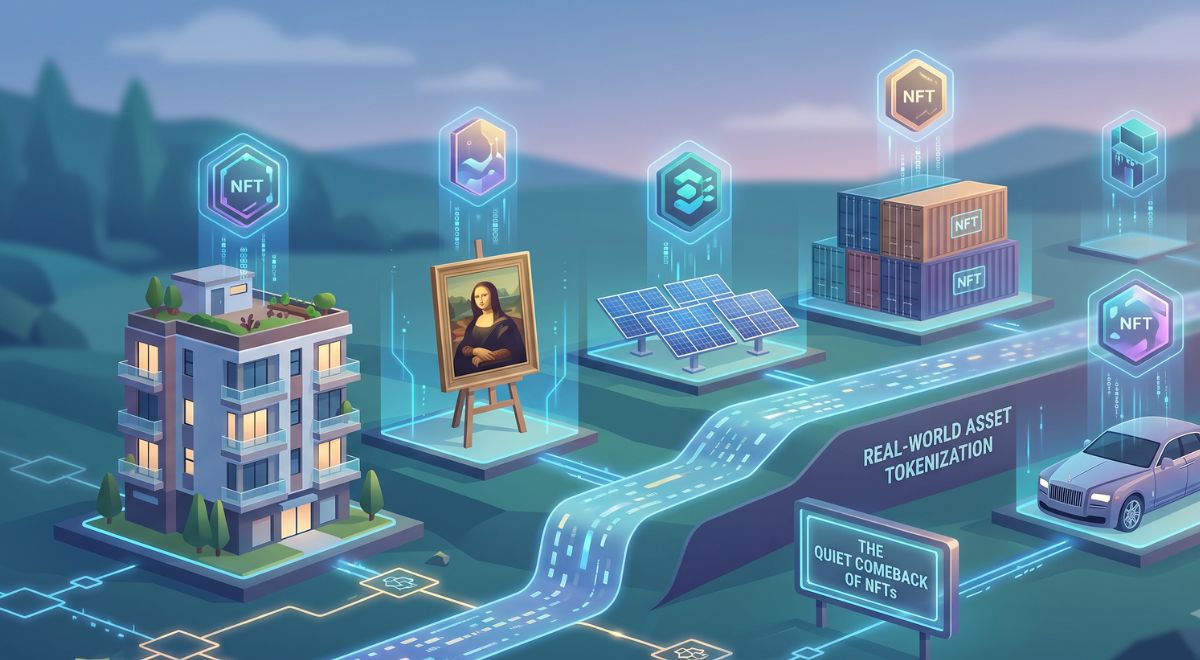
Non-fungible tokens (NFTs) are quietly finding a new role in the digital asset economy, shifting away from the speculative boom that defined their peak in 2022 and toward the tokenization of real-world assets.
While NFTs have struggled to match the growth of cryptocurrencies and stablecoins in recent years, the market is showing signs of renewed activity in 2026 as companies and financial institutions increasingly explore blockchain-based representations of physical and traditional financial assets.
Cryptocurrency trading activity reached record levels in 2025. Combined spot and perpetual derivatives trading volume on centralized exchanges climbed to $86.2 trillion, up 47.4% from 2024. Decentralized exchanges also recorded a record $6.7 trillion in perpetual trading volume.
Stablecoins experienced similarly strong growth, with transaction volume reaching approximately $46 trillion in 2025 as their use expanded across payments and financial services.
NFTs followed a different trajectory. Annualized NFT sales fell 37% to about $5.63 billion in 2025. However, the market has begun showing signs of recovery. NFT sales reached approximately $2.8 billion during the first half of 2026, as brands and investors increasingly connect NFTs with the broader real-world asset (RWA) tokenization trend.
What Is Real-World Asset Tokenization?
Real-world asset tokenization refers to representing an asset on a blockchain through a digital token. The underlying asset can be physical, such as real estate, gold, artwork or collectibles, or financial, such as government bonds, stocks and corporate debt.
Tokenization is designed to bring assets traditionally traded through conventional financial systems onto blockchain networks, potentially making them easier to access, transfer and trade.
Some tokenized assets are directly backed by physical assets. Paxos, for example, issues PAXG, a token backed by physical gold. Each PAXG token represents one fine troy ounce of gold held in custody, with the token’s value designed to track the price of gold.
Tether also operates a tokenized gold product called Tether Gold (XAUT). Together, Paxos and Tether have brought more than $3.1 billion worth of gold onto blockchain networks.
The RWA sector extends well beyond commodities. Tokenization is being explored across U.S. Treasuries, corporate credit, private equity, venture capital, real estate, specialty finance, intellectual property, luxury goods, art and collectibles.
In broad terms, tokenization can either provide direct ownership or rights associated with an asset, or create a digital token designed to track the value of an underlying asset without granting direct ownership.
Why NFTs Are Reappearing in the RWA Market
The growing RWA sector is creating new applications for NFTs. Unlike traditional fungible tokens, NFTs have unique identifiers, making them suitable for representing individual physical objects, ownership records and certificates of authenticity.
Chainlink describes tokenized NFTs as blockchain-based digital representations of real-world assets. Their unique token IDs and blockchain records can help establish provenance and distinguish one physical asset from another.
One example is Courtyard, which has developed a system for tokenizing physical collectibles, including Pokémon trading cards. The physical cards undergo verification through a third party to confirm their authenticity and condition before being represented digitally.
Once verified, the tokenized collectibles can be held, displayed or traded through NFT marketplaces, creating a bridge between physical collectibles and blockchain-based ownership.
Tokenization is also expanding into equities. Several crypto platforms now offer access to a limited range of stocks and market indices through blockchain-based trading systems. Other platforms have expanded their offerings to include currencies, metals and commodities.
This development effectively brings parts of traditional finance onto blockchain infrastructure, allowing users to gain exposure to familiar markets through on-chain platforms.
Institutions Accelerate RWA Adoption
Financial institutions are increasingly becoming a major force behind the RWA tokenization market.
BlackRock has emerged as one of the most prominent institutional participants. CEO Larry Fink has described tokenization as the next generation of financial markets, while the asset manager has indicated plans to tokenize a significant portion of its assets.
In March 2024, BlackRock launched the BlackRock USD Institutional Digital Liquidity Fund (BUIDL) in partnership with Securitize.
BUIDL is a tokenized money market fund that primarily invests in U.S. Treasury bills, cash and repurchase agreements. Its growth has helped demonstrate increasing institutional interest in blockchain-based representations of traditional financial products.
Other real-world assets are also being explored through tokenization.
The St. Regis Aspen Resort in Colorado has been associated with fractional ownership through the tokenized Aspen Coin, while Titanic Distillers has offered exposure to maturing Irish whiskey through CaskCoin.
Meanwhile, companies including OpenEden Labs, Invesco, Franklin Templeton and Matrixdock have developed blockchain-based products linked to U.S. Treasury bills.
The tokenized U.S. Treasury market has grown into a significant segment of the RWA ecosystem, with the market valued at around $15.92 billion and covering 85 assets, including Treasury bills, notes, bonds and Treasury-focused money market funds.
The Role of Blockchain Infrastructure
As more traditional assets move onto blockchains, infrastructure providers are playing an important role in connecting on-chain tokens with their real-world counterparts.
Companies such as Chainlink provide technology designed to transfer data between blockchain networks and external systems. This connection is particularly important for RWAs because the value and status of a digital token often depend on information that exists outside the blockchain.
For example, an NFT representing a physical collectible needs reliable information about the asset’s authenticity and ownership. Similarly, a token representing a financial asset requires accurate data about the underlying investment.
Proof-of-reserves systems and third-party verification are therefore becoming important components of the RWA ecosystem.
According to Chainalysis, the RWA market had grown beyond $30 billion by 2026, reflecting increasing interest from institutional investors.
What Comes Next for NFTs and RWAs?
NFTs may no longer be defined primarily by digital artwork and speculative collectibles. Their ability to provide unique identifiers and ownership records makes them potentially useful for representing physical assets and rights on blockchain networks.
Current applications include art and collectibles, real estate and ownership certificates. However, financial assets such as Treasury bills, credit products and debt are attracting much of the capital flowing into the broader RWA sector.
The industry still faces challenges, particularly around establishing a reliable connection between physical assets and their digital representations. A blockchain can record ownership of a token, but mechanisms are still required to prove that the token is genuinely backed by the asset it represents.
Third-party verification, custodial arrangements and proof-of-reserves systems are among the approaches being used to address this problem.
The renewed interest in NFTs therefore represents a significant shift from the speculative boom of the previous cycle. Rather than disappearing, NFTs may be evolving into infrastructure for representing unique real-world assets, ownership rights and authenticity on blockchain networks.
As tokenization expands across traditional finance and physical assets, NFTs could play a quieter but increasingly important role in bringing the real economy onto blockchain rails.