
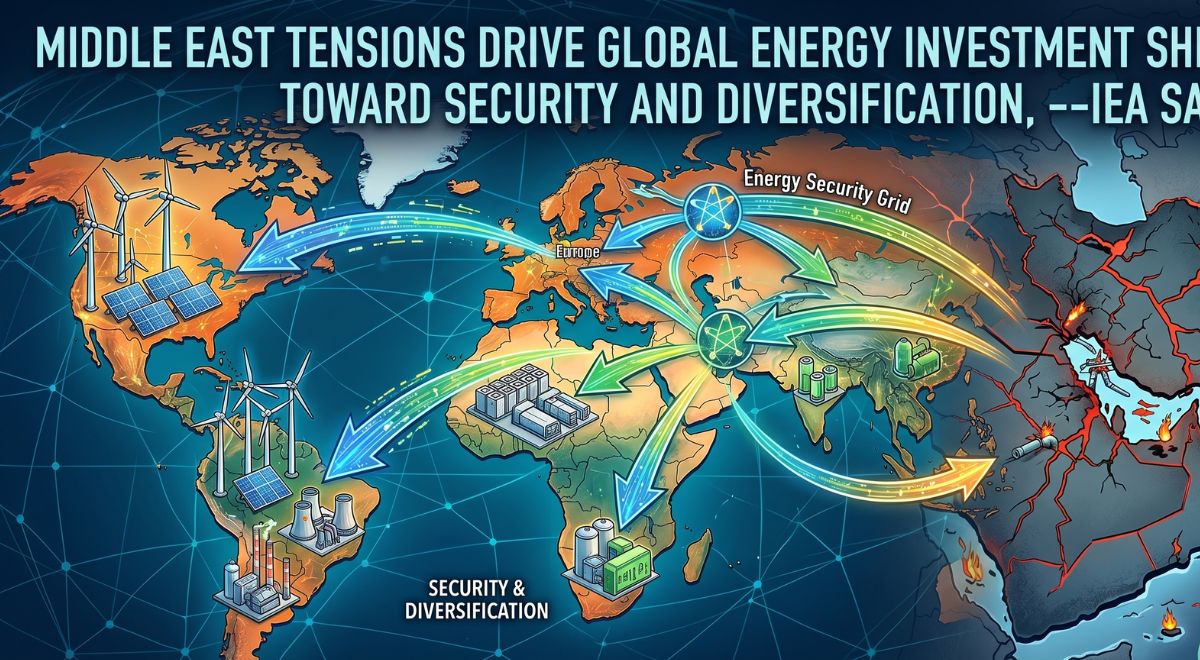
The ongoing conflict in the Middle East is accelerating a global shift in energy investment priorities, with security, trust, and supply diversification becoming increasingly important considerations for governments and businesses, according to the latest World Energy Investment 2026 report from the International Energy Agency (IEA).
The agency said geopolitical instability is prompting countries to place greater emphasis on energy resilience alongside traditional factors such as costs, pricing, and environmental performance when selecting energy projects and partners.
According to the report, disruptions linked to the conflict are reshaping investment strategies worldwide and could leave a lasting mark on future energy development plans. The impact has been particularly significant in Asia and the Middle East, regions that traditionally receive between 80% and 90% of energy exports from Gulf producers and have been heavily affected by disruptions to shipping routes through the Strait of Hormuz.
As concerns over energy security grow, the IEA expects renewed interest in domestically available energy resources. For major fuel-importing nations, this could create new opportunities for renewable energy, nuclear power, and, in some cases, coal.
Early signs already suggest that renewable energy deployment is gaining momentum in several markets that have been most exposed to the recent energy crisis.
The report forecasts global investment in electricity supply and infrastructure to reach $1.6 trillion in 2026. When spending on end-use electrification is included, total investment is expected to rise to approximately $2 trillion.
Spending on electricity grids is projected to approach $550 billion this year, representing an annual increase of nearly 20%, while investment in battery energy storage systems is expected to surpass $100 billion.
“We are in the midst of the largest energy security crisis the world has ever faced,” said IEA Executive Director Fatih Birol. He added that the current situation could reshape global energy investment patterns in a manner comparable to the oil shocks of the 1970s.
Despite the growing focus on energy security, many of the conflict’s long-term effects are yet to be fully reflected in investment figures. The IEA noted that around three-quarters of energy investments planned for 2026 were approved before the current conflict began, meaning many impacts will only become visible in the coming years.
Overall, global energy investment is expected to reach $3.4 trillion in 2026, a slight increase from the previous year. Approximately $2.2 trillion will be directed toward power grids, energy storage, low-emission fuels, nuclear power, renewable energy, efficiency measures, and electrification projects. The remaining $1.2 trillion is expected to be invested in oil, natural gas, and coal.
While higher oil prices might typically encourage additional spending, oil investment is forecast to decline for a third consecutive year, falling below $500 billion. In contrast, natural gas investment is expected to rise to $330 billion, marking the highest level in a decade. The increase is being driven by a wave of new liquefied natural gas (LNG) export projects, particularly in the United States and Qatar.
Renewable energy remains the dominant destination for power-sector investment. The IEA projects that spending on renewable power projects will reach approximately $665 billion in 2026, including around $365 billion dedicated to solar energy. Although growth has moderated after several years of rapid expansion, low-emission technologies continue to account for more than 70% of total global power generation investment.
Meanwhile, investment in nuclear energy is expected to exceed $80 billion annually, supported by nearly 80 gigawatts of new nuclear capacity currently under construction across 15 countries.
Coal investment is also projected to increase, reaching $180 billion in 2026—the highest level since 2012. China is expected to account for almost 70% of total global coal spending.
The IEA concluded that geopolitical uncertainty is increasingly shaping the global energy landscape, influencing not only where capital is invested but also how countries pursue long-term energy security and sustainability goals.