

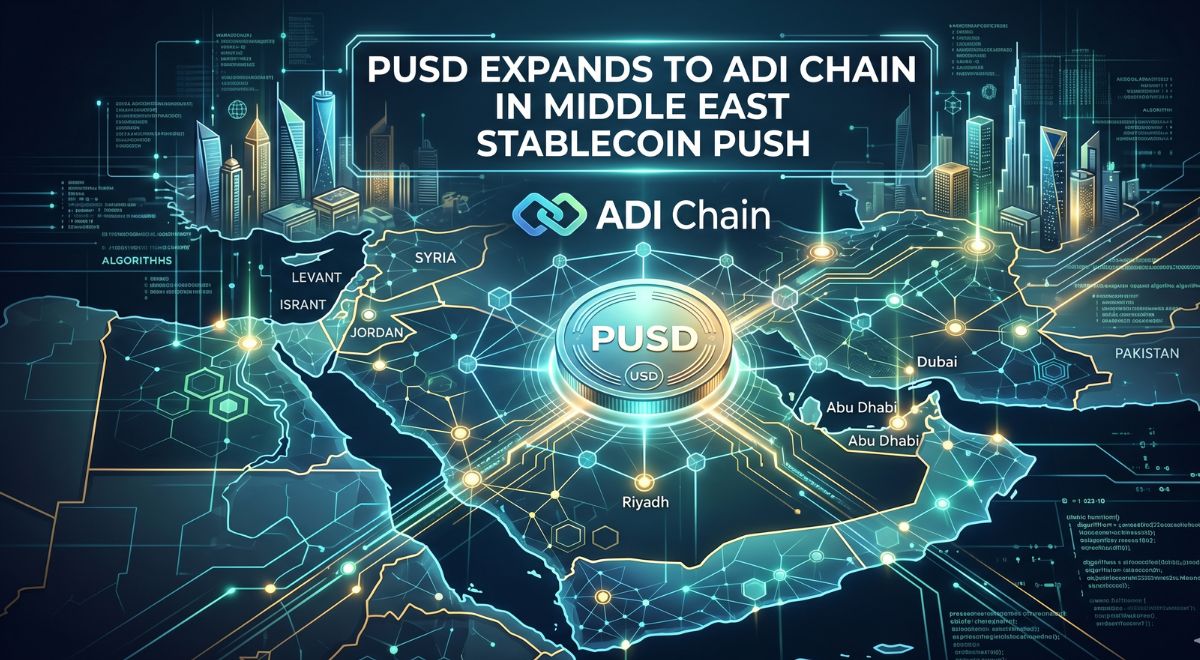
The global race to modernize financial systems through digital assets is accelerating, and the Middle East is quickly emerging as a key battleground. In a significant development, PUSD—a Shariah-compliant stablecoin—has expanded to the ADI Chain, signaling a major خطوة forward in the region’s push toward blockchain-powered finance.
A Strategic Expansion into the Middle East
PUSD’s integration with ADI Chain marks its latest move to strengthen its presence in the Middle East’s rapidly evolving digital economy. ADI Chain is a Layer 2 blockchain specifically designed for institutional settlement, making it an ideal infrastructure for financial institutions seeking faster and more efficient transaction systems.
This expansion introduces PUSD as an additional settlement option on the network, alongside existing dirham-backed digital assets. The result is a more flexible ecosystem where institutions can transact using either dollar-linked or local currency-backed stablecoins within the same framework.
Backed by Gulf Currencies and Islamic Finance Principles
One of PUSD’s defining features is its compliance with Islamic finance principles. The stablecoin is backed 1:1 by reserves held in Saudi riyals and UAE dirhams—both currencies pegged to the U.S. dollar—ensuring stability and transparency.
With an estimated circulation of around $2.3 billion, PUSD is already a significant player in the stablecoin market. Its Shariah-compliant structure makes it particularly attractive to institutions operating within the Islamic finance ecosystem, which is valued at over $3 trillion globally.
Unlocking Cross-Border Payments and Institutional Use
The deployment on ADI Chain is not just a technical upgrade—it’s a strategic move aimed at improving cross-border payments across the Gulf, Middle East, and even parts of Africa. The network is designed to facilitate institutional-grade transactions, including those by banks, corporate treasuries, and payment processors.
By combining blockchain efficiency with regulatory alignment, PUSD aims to reduce friction in international settlements, lower transaction costs, and increase liquidity in regional markets.
Regulatory Momentum in the UAE
This expansion comes at a time when the United Arab Emirates is actively building a robust regulatory framework for digital assets. Authorities such as the Central Bank of the UAE and Abu Dhabi Global Market are introducing policies to support stablecoins and virtual asset providers.
The inclusion of PUSD on ADI Chain aligns with these efforts, reinforcing the UAE’s ambition to become a global hub for digital finance and blockchain innovation.
A Broader Shift Toward Digital Finance
PUSD’s move highlights a broader trend: the convergence of traditional finance and blockchain technology in the Middle East. As institutions increasingly seek compliant, efficient, and scalable solutions, stablecoins—especially those aligned with regional financial principles—are gaining traction.
In this context, the expansion to ADI Chain is more than just another integration. It represents a خطوة toward a new financial infrastructure where digital assets play a central role in institutional finance, cross-border trade, and economic growth across the region.