
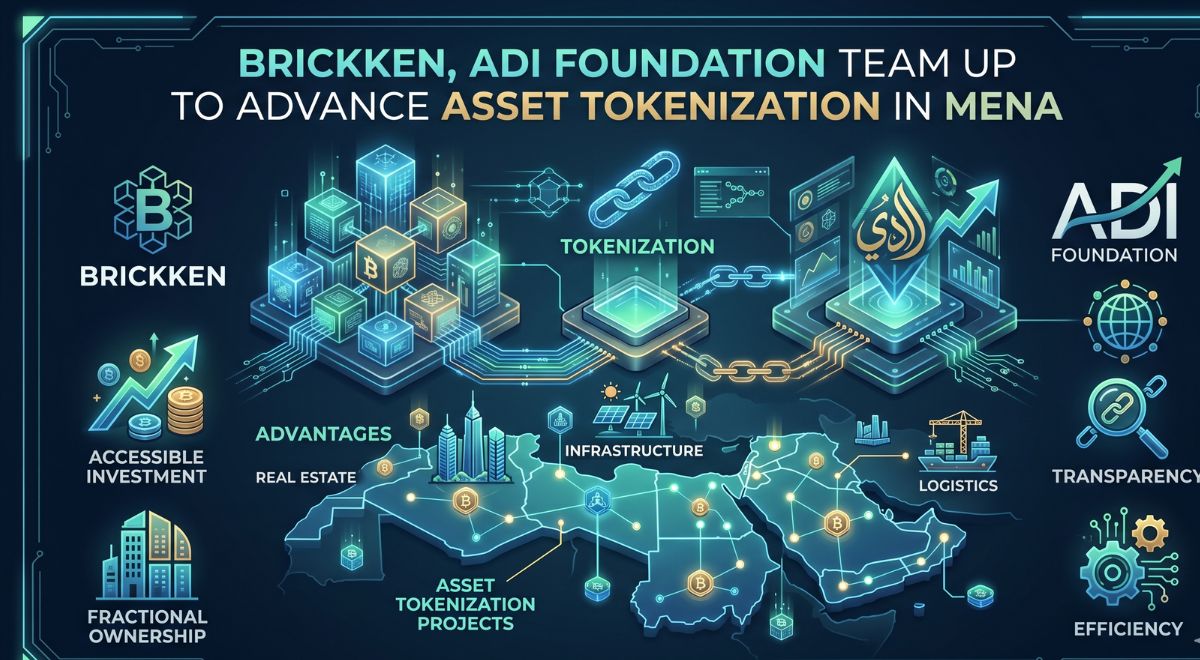
Tokenization infrastructure firm Brickken has entered into a strategic partnership with ADI Foundation to roll out institutional-grade systems for real-world asset (RWA) tokenization across the Middle East and North Africa (MENA). The agreement, announced on April 29, focuses on deploying advanced blockchain-based tools via the ADI Chain, enabling governments and financial institutions to issue and manage digital financial assets more efficiently.
Building Institutional-Grade Blockchain Infrastructure
Under the collaboration, Brickken will integrate its asset issuance technology with the ADI Chain, a Layer-2 blockchain tailored for stablecoins and tokenized assets. The combined infrastructure is designed to support compliant onboarding and lifecycle management of a wide range of asset classes, including equities, debt instruments, private credit, real estate, and investment funds.
Officials from both organizations emphasized that the system will enable regulated tokenization and controlled secondary market distribution. Notably, the ADI Chain also functions as settlement infrastructure for a UAE dirham-backed stablecoin licensed by the country’s central bank, strengthening its institutional credibility.
Rising Demand for Tokenized Assets
The partnership comes as Brickken reports significant growth in its ecosystem. Speaking at Consensus Hong Kong 2026, CEO Edwin Mata revealed that the platform has surpassed $450 million in tokenized assets. He highlighted a shift in market demand, with increasing interest in digitizing assets such as gold, credit, and bonds, beyond the traditionally dominant real estate sector.
Mata described RWAs as increasingly essential for emerging markets, pointing to Southeast Asia and the Philippines as key regions where improved liquidity and financial infrastructure are driving adoption.
MENA’s Growing Role in Crypto and Blockchain
The ADI Foundation said the partnership reflects rising institutional engagement across the MENA region. Data from Chainalysis indicates that the United Arab Emirates recorded more than $56 billion in crypto transactions between 2024 and 2025.
According to Andrey Lazorenko, the initiative enables regional institutions to transition from exploring tokenization to actively issuing digital assets. The ADI Foundation, part of Sirius International Holding under IHC, is focused on expanding blockchain infrastructure across emerging markets in the Middle East, Asia, and Africa.
Toward Standardization and Liquidity
To tackle fragmentation in the tokenization space, Brickken has co-developed EIP-7943, an open standard aimed at improving interoperability. The company reports that approximately $41 million in total value locked (TVL) within its smart contracts is already eligible for secondary market trading.
Looking ahead, Brickken plans to collaborate with over-the-counter (OTC) trading desks within the next year to enhance liquidity for tokenized assets. Mata noted that while traditional financial institutions are entering the blockchain sector, their focus remains on stable, asset-backed instruments rather than speculative digital tokens.