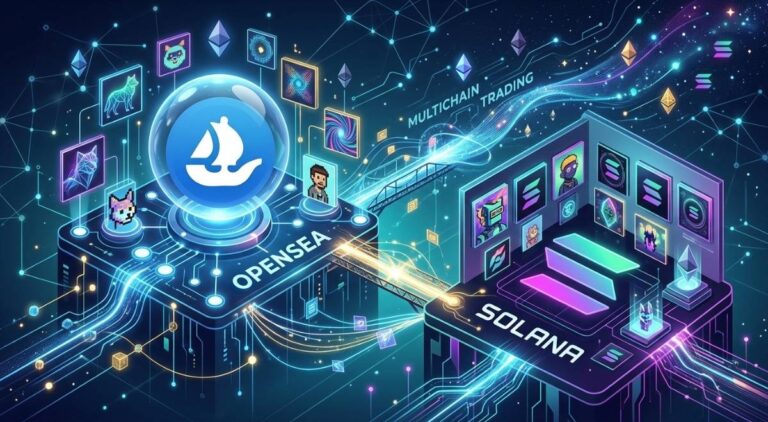

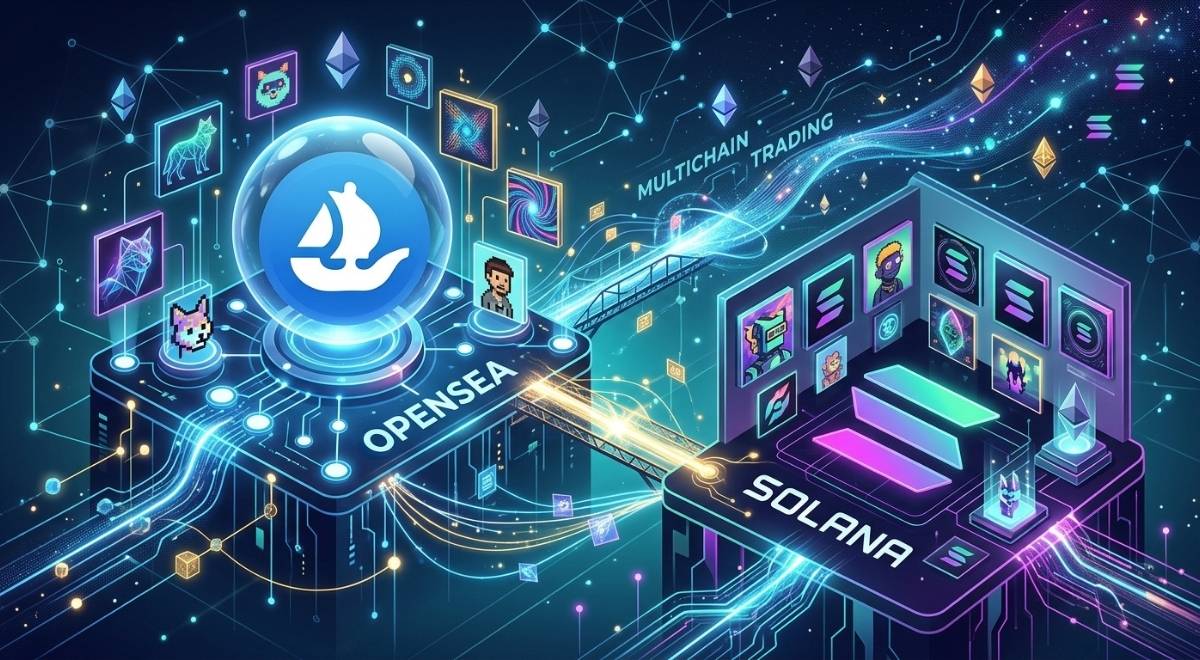
OpenSea has officially expanded its NFT marketplace to support trading of non-fungible tokens built on the Solana blockchain, strengthening the platform’s broader push toward multichain digital-asset trading.
The development marks OpenSea’s return to the Solana NFT market roughly four years after it ended an earlier beta initiative in April 2022. Solana is also the first non-Ethereum Virtual Machine (EVM) blockchain to receive NFT trading support on OpenSea.
According to The Block, users have been able to buy, sell and trade Solana-based NFTs directly through OpenSea since March 31. Several well-known collections from the Solana ecosystem, including Claynosaurz, Mad Lads, BoDoggos, Collector Crypt and Phygitals, are now available on the marketplace.
The integration is being delivered through OS2, OpenSea’s next-generation trading platform designed to bring multiple blockchain networks into a single interface. The platform supports NFT and fungible-token trading across more than 19 blockchain networks.
OpenSea had already introduced support for Solana’s native SOL token through OS2 in April last year. At the time, the company indicated that NFT support would eventually follow.
“OS2 was rebuilt from the ground up as a multichain platform,” OpenSea said, describing the Solana NFT integration as the next stage of that strategy. The company also pointed to the expanding number of collectibles and NFT-related platforms operating within the Solana ecosystem as a factor behind the decision.
OpenSea Takes a Different Approach to Its Earlier Solana Launch
OpenSea’s first attempt to support Solana NFTs came in April 2022, when the marketplace launched a limited beta program. The service initially covered about 165 collections but struggled to gain significant traction before being discontinued.
At the time, Magic Eden and Tensor dominated much of the Solana NFT trading activity, making it difficult for OpenSea to establish a strong position.
The latest launch comes under different circumstances. OpenSea now has dedicated multichain infrastructure through OS2, while its current Solana offering is not restricted to a small selection of collections.
The broader development of the Solana NFT ecosystem has also created a larger market for marketplaces seeking exposure to blockchain-based collectibles.
OpenSea already supports NFT trading across several networks, including Ethereum, Polygon, Arbitrum, Optimism, Avalanche, Base, Monad, Sei and Berachain. Most of these networks are compatible with the EVM, making Solana a notable addition because it operates outside that ecosystem.
Multichain Expansion Comes as NFT Market Remains Under Pressure
OpenSea’s expansion into Solana comes at a time when the wider NFT market remains significantly smaller than during its 2021–2022 peak.
NFT marketplace trading volumes that once reached billions of dollars per month have fallen into the hundreds of millions of dollars range, according to data cited by The Block. The prolonged market downturn has also contributed to the closure or restructuring of several NFT-related platforms.
Binance ended its centralized NFT service in June, while Nifty Gateway, Kraken NFT and X2Y2 have also exited or scaled back their NFT operations in recent years. The Block Research has projected that marketplace trading volumes could face further pressure in 2026.
Despite those challenges, Solana remains an important part of the NFT market, and competition among marketplaces continues to evolve.
Magic Eden has recently reduced its focus on Bitcoin and EVM-based marketplaces while directing more resources toward Solana. Tensor, another major player in the ecosystem, also continues to maintain a strong presence in Solana NFT trading.
OpenSea’s renewed entry could therefore increase competition between the leading Solana marketplaces as platforms compete for traders, collections and transaction volume.
OpenSea Broadens Focus Beyond NFTs
The Solana NFT launch is part of a wider shift in OpenSea’s strategy. The company has increasingly moved beyond traditional NFT trading by introducing support for fungible tokens through OS2.
OpenSea has also discussed plans for a SEA governance token, although it has not provided a confirmed launch timeline.
The broader strategy suggests that OpenSea is seeking to transform OS2 from an NFT-focused marketplace into a more comprehensive multichain trading platform covering both digital collectibles and cryptocurrencies.
With Solana now included in its NFT offering, OpenSea is taking another step toward that goal while re-entering one of the most active ecosystems outside the EVM-based blockchain market.