
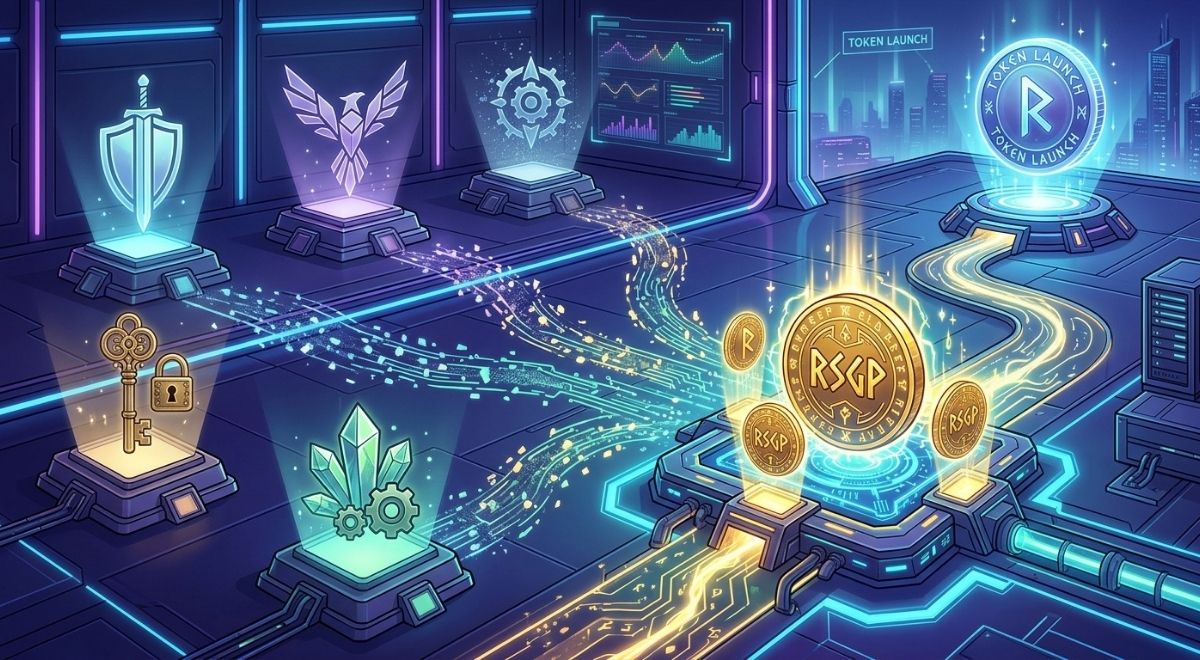
Cambria is moving to simplify its onchain gaming ecosystem by retiring four NFT and token collections and transferring their utility into its upcoming RSGP token economy.
The studio said snapshots for the affected collections will be taken on August 28, 2026, at 10 a.m. PT, 1 p.m. ET and 7 p.m. CET, ahead of the RSGP genesis launch scheduled for September.
The collections being deprecated are Founder NFTs, Cores, Companions and Arena Tokens. Their respective functions will be incorporated into RSGP, in-game systems or staking mechanisms.
Meanwhile, Islands NFTs will remain unchanged, while offchain game assets such as Pendants, Charm Cards and Cosmetics will continue operating as before.
Why Cambria Is Consolidating Its Ecosystem
Tempest Labs, the studio behind Cambria, said the decision is primarily aimed at reducing fragmentation across the game’s asset economy.
According to the studio, having multiple assets with separate value-accrual mechanisms created competition between collections and made it harder for any individual asset to develop meaningful utility. With utility spread across several collections and multiple blockchains, the system also became more difficult for new users and potential holders to understand.
Development and maintenance costs were another factor.
Each onchain collection requires ongoing work involving smart contracts, staking systems, audits, game integration, economic balancing and customer support. The studio said maintaining these systems increasingly consumed development resources, causing updates that could have taken weeks to stretch into months.
Cambria also pointed to a mismatch between long-term economic assumptions and current market valuations. Collections such as Islands and Cores were designed around a much larger future player base, where systems such as land taxation and cosmetic production could support significant economies.
The studio’s view was that these mechanisms were built for the game’s eventual scale, while holders naturally valued the assets based on their current utility and player population.
What Happens to Founder NFTs?
Founder NFTs will complete their existing lifecycle at the August 28 snapshot.
The collection consists of 1,500 NFTs minted on Ethereum on September 17, 2024, at 0.1 ETH each. Holders will receive an RSGP allocation through the Genesis Airdrop.
The allocation will consist of two components: a fixed amount assigned per NFT and a variable component determined by factors including Loyalty Score, First Founder status and Points.
Approximately 400 First Founders have reportedly held their NFTs continuously since the original mint.
Founder benefits will not disappear. Instead, they will be transferred into RSGP holder tiers.
These benefits include points multipliers, Gold Rush bribe multipliers ranging from 1.5x to 4x depending on holdings, waived Trading Post listing fees, increased order capacity, a capped vault tax on Royal Favor withdrawals, guild creation privileges and login queue priority.
Additional benefits include a 10% Energy Orb restoration boost, Ser and Lady titles, exclusive heirloom cosmetics and the Founder Falcon companion.
Roadmap features such as the proposed Founders’ Hall and Scroll-style progression will also be incorporated into the new tier system. Unlike the current Founder NFT structure, these benefits will not be limited to the original 1,500 wallets.
Cores Shift From NFTs to RSGP Staking
The Cores collection will also be deprecated, with its core economic function moving into RSGP staking.
The collection contains 10,000 Factory NFTs on Ronin, minted in December 2024 at 20 RON each. The NFTs were divided into four tiers: 80% Normal, 15% Enhanced, 4% Mystic and 1% Arcane, with output multipliers ranging from 1x to 5x.
Previously, staking Cores generated soulbound Cosmetic Shards. Under the new system, staking RSGP will provide access to the same broader ecosystem functions, beginning with Cosmetic Shard generation.
The studio said the transition will preserve downstream mechanics involving Companions, cosmetics and burn-to-earn systems.
Existing Cosmetic and Companion Shards will also migrate directly.
In addition, the highest Core Tier previously owned by a player will become a permanent, soulbound attribution on that player’s account. This will allow former Core holders to retain eligibility for future rewards and drops as original collectors.
Companions Move Into the Game
Companion NFTs will leave the blockchain and become entirely in-game assets.
Cambria has minted 27,723 Companions to date. Each Companion was procedurally generated with characteristics including an archetype, personality matrix, catchphrase and Heritage Index.
The NFTs also provided gameplay features such as Auto Pickup, Bank All, Remote Crafting, Remote Repair, Remote General Store and Offscreen Indicators.
Following the transition, Companions will be traded through Clara’s Companion Bazaar using Keys or future in-game spending tokens.
Cambria described the move as a way to make Companion collecting more accessible to players who are unfamiliar with cryptocurrency and blockchain-based assets.
Arena Tokens Join the Unified Economy
Arena Tokens will also be retired as a standalone asset and incorporated into Cambria’s broader economy.
The studio pointed to an earlier transition involving Arena Tokens v1, when balances were automatically converted into Cosmetic Shards at a rate of 1,000 Arena Tokens to one Cosmetic Shard. Those balances were also retroactively included in the relevant airdrop calculations.
Current Arena Token balances will follow a similar transition process.
Players who prefer direct utility will also have the option of using a final burn mechanism to convert Arena Tokens into Keys.
Cambria’s Growing Onchain Economy
The consolidation follows significant activity across Cambria’s games.
The project has recorded more than $160 million in lifetime onchain game volume, more than $3 million in revenue across live games and a peak concurrent player count of approximately 3,800 since development began in spring 2023.
Much of the activity has been driven by Gold Rush.
During Season 1 in December 2024, more than 9,600 players participated in a five-day competition involving approximately $209,000 in player risk capital, while $226,000 was distributed back to players.
Season 2 in May 2025 generated approximately $1.3 million in spending over two weeks and featured an 832 ETH prize pool valued at around $1.52 million at the time.
Season 3 in December 2025 processed approximately $1.7 million over 10 days, covering 24,523 Charters and 233,850 Energy Orbs. The player-driven silver economy reached approximately 41.5 billion silver, valued at around $1.28 million at settlement.
The studio has also expanded the ecosystem between major Gold Rush seasons.
Dungeons launched in May as a roguelike risk-based crawler, while Dungeon Fishing entered early beta in July 2026. The latter allows players to spend Grub to fish for sacks of gems, Charm Cards and NFTs that can ultimately be converted into Keys.
Cores Staking Built a Separate Economy
Before Burn to Earn Round 0 closed in October 2025, Core stakers had burned 92,406 Cosmetic Shards while competing for a pool containing 1.1 billion Arena Tokens.
One player alone committed 80,000 Cosmetic Shards for a position worth 328 million Arena Tokens.
The staking system operates through 14-day cycles and currently pools half of the Arena Tokens spent on Dungeon Keys and Trading Post fees.
The retirement of Cores is intended to move these economic functions into the broader RSGP staking system rather than eliminate them.
Islands NFTs Will Remain
Unlike the four deprecated collections, Islands NFTs will continue operating under their existing model.
The collection contains 3,333 NFTs minted on Ethereum in October 2025 at 0.1 ETH each.
Islands function as the ownership and guild layer of Cambria’s Archipelagos. Holders receive a writ of dominion that allows them to host player-owned Islets, establish taxes and laws, and receive a share of Islet purchases.
Island owners also receive 15% of hosted Supply Drive output.
The first version of the system launched in January 2026 and included configurable favor tax rates of up to 80%, tier-based capacity ranging from five to 60 hosted Islets, Gold Rush bribe multipliers of up to 1.5x and Companions that can appear as living NPCs across islands.
Pendants and Charm Cards Stay
Pendants and Charm Cards are also unaffected by the consolidation.
Cambria has minted 1,743 Genesis Pendants, of which 1,591 have been revealed and 152 remain unrevealed.
The Pendants can be traded in-game through Mina’s Compendium and provide a Cut Gem boost alongside stat bonuses in Dungeons.
Charm Cards provide weekly packs from Essina, Mina and Matilda to Pendant holders and staked Tier 2-plus Core holders. Burning cards will eventually unlock additional features such as voice lines, emotes and aura projections.
RSGP Launch Set for September
Cambria’s broader objective is to create a single economic layer around RSGP rather than maintain several competing onchain assets.
The studio said detailed allocation figures for each collection and season will be released alongside the project’s tokenomics ahead of the TGE claim.
The RSGP token is scheduled to launch in September 2026, with the Genesis campaign already underway.
Gold Rush Season 4 is also expected to arrive around the token generation event, with Cambria positioning it as its largest season to date.
The consolidation marks a significant change in Cambria’s Web3 strategy: instead of expanding its ecosystem through additional standalone assets, the studio is attempting to bring existing utility, rewards and player incentives together under a single token economy.