
GALLEN, Switzerland — The once-booming non-fungible token (NFT) market may have faded from the spotlight, but new academic research suggests it remains a valuable case study for understanding investor psychology in digital asset markets.
A study by researchers at the University of St. Gallen (HSG) has found that NFT investors consistently make emotionally driven investment decisions, often selling profitable assets too quickly while holding on to losing positions for extended periods. The behaviour reflects the well-known “disposition effect,” a psychological bias that has long been observed in traditional financial markets but appears significantly stronger in the NFT ecosystem.
Study Analyses More Than 722,000 NFT Transactions
Researchers Andrea Barbon, Charles Milliet and Prof. Dr. Matthias Weber examined over 722,000 NFT transactions involving more than 180,000 digital wallets on OpenSea, one of the world’s largest NFT marketplaces.
According to the researchers, the analysis provides some of the strongest evidence to date that behavioural finance principles apply not only to stock markets but also to digital asset ecosystems, where objective valuation methods are often limited.
The findings come as financial institutions, exchanges and regulators continue exploring the tokenisation of real-world assets, including real estate, artwork and other investment products. At the same time, advances in generative artificial intelligence are driving the creation of new categories of digital assets and collectibles.
Prof. Weber said NFTs provide an ideal environment for studying investor behaviour because pricing often depends more on expectations and market sentiment than measurable fundamentals.
Investor Bias Three Times Stronger Than in Stock Markets
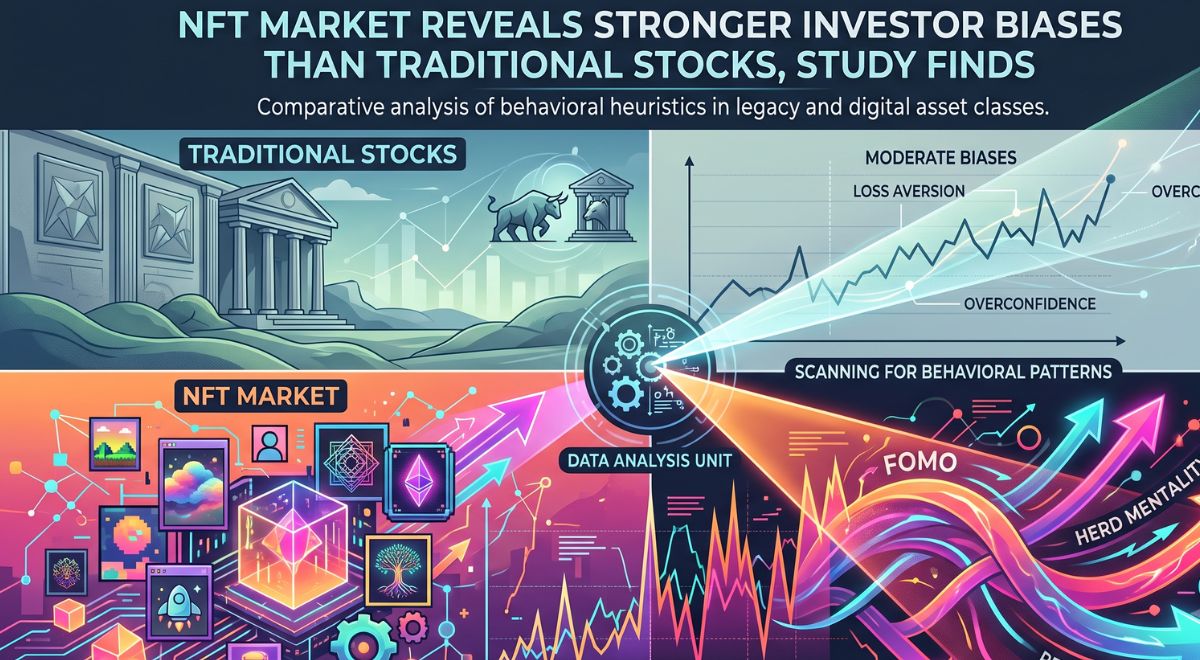
The study found that the disposition effect in NFT trading is approximately three times stronger than in traditional equity markets.
In practice, this means investors frequently lock in gains quickly by selling assets that have appreciated, while refusing to sell declining assets in hopes prices will eventually recover.
Researchers attribute the stronger behavioural bias to several factors, including the dominance of retail investors and the absence of widely accepted valuation models for NFTs. Without clear benchmarks for determining fair value, investment decisions are more likely to be influenced by emotions and speculation.
Low Liquidity Also Influences Trading Decisions
Beyond investor psychology, the research highlights the role of market liquidity in shaping trading behaviour.
Unlike publicly traded stocks, many NFTs cannot be sold immediately because suitable buyers may not be available. To address this, the researchers introduced a new methodology that measures investor behaviour from the moment an NFT is listed for sale rather than when the transaction is completed.
Using this approach, the measured disposition effect falls by roughly half, indicating that a significant portion of the observed behaviour results from market illiquidity rather than investor decision-making alone.
The researchers believe the methodology could also be applied to other illiquid asset classes such as property, artwork and future tokenised real-world assets.
Experience Does Not Eliminate Behavioural Bias
The study also found that experienced NFT traders remain just as vulnerable to the disposition effect as occasional investors, a notable contrast with traditional financial markets, where seasoned investors often demonstrate more disciplined trading behaviour.
Researchers additionally observed that NFT investors are more likely to realise losses toward the end of the calendar year, suggesting tax-related considerations may influence selling decisions. According to the study, this is the first time such seasonal behaviour has been documented for blockchain-based digital assets.
Broader Implications for Digital Asset Markets
The researchers believe the findings could extend beyond NFTs to other speculative digital assets, including cryptocurrencies and memecoins, where market sentiment often outweighs traditional valuation metrics.
As tokenisation expands across global financial markets, understanding how behavioural biases influence investor decisions could become increasingly important for policymakers, financial institutions and market participants.
Key Findings
- NFT investors tend to sell profitable assets too early while holding losing positions for longer periods.
- The disposition effect is around three times stronger in NFT markets than in traditional stock markets.
- Market illiquidity significantly amplifies the behavioural bias.
- A newly developed measurement model offers more accurate analysis of investor behaviour in illiquid markets.
- The methodology could also be applied to tokenised real estate, art and other alternative assets.
The research, titled “The Disposition Effect in the NFT Market,” was authored by Andrea Barbon, Charles Milliet and Matthias Weber and published as a working paper on SSRN in March 2026.