
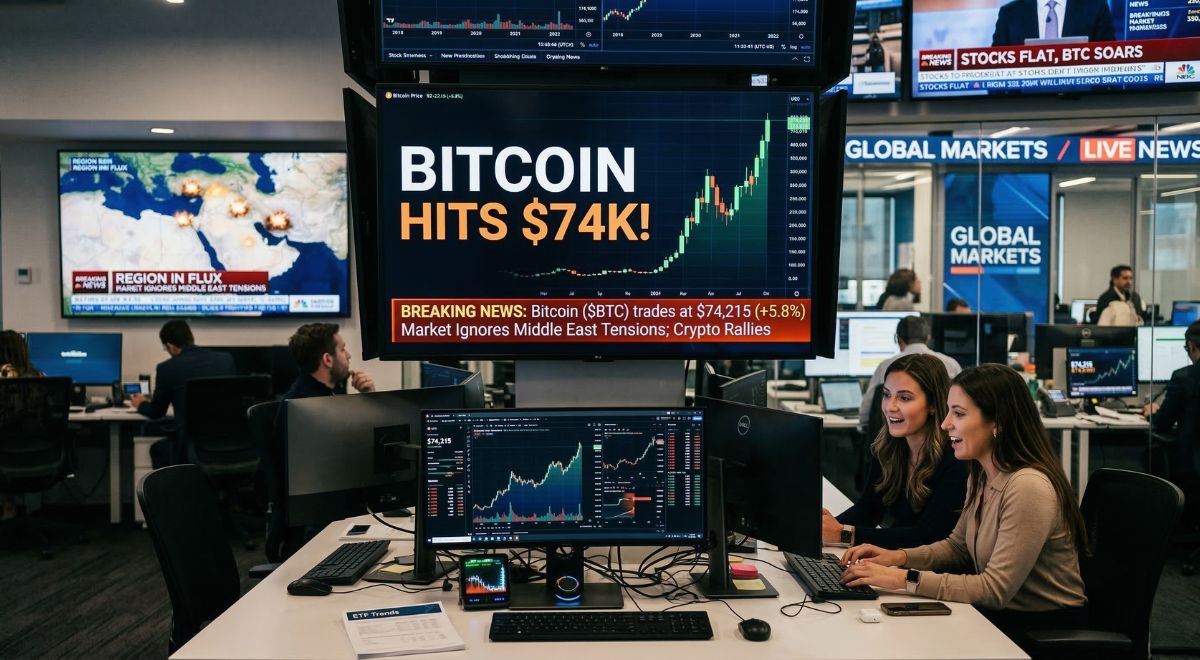
March 2026 — The global cryptocurrency market is once again defying expectations, with Bitcoin surging past the $74,000 mark despite escalating geopolitical tensions across the Middle East. While traditional financial markets often react sharply to regional instability, Bitcoin appears to be charting its own course—highlighting its evolving role in the global financial system.
A Rally Against the Odds
Historically, geopolitical conflicts—especially in the Middle East—have triggered volatility in global markets. Oil prices spike, equities fluctuate, and investors typically seek safe-haven assets like gold or government bonds. However, this time, Bitcoin’s upward momentum suggests a different narrative.
Instead of retreating amid uncertainty, investors are pouring capital into digital assets. The surge to $74K reflects strong market confidence, fueled by institutional demand, limited supply dynamics, and growing mainstream adoption.
Why Is Bitcoin Rising?
Several factors are driving Bitcoin’s bullish performance:
1. Institutional Demand Remains Strong
Major financial institutions continue to increase their exposure to Bitcoin. Spot Bitcoin ETFs and crypto-focused investment funds have attracted billions in inflows, reinforcing confidence among retail and professional investors alike.
2. Supply Constraints Post-Halving
Bitcoin’s supply mechanism plays a critical role in price movements. Following the most recent halving event, the rate at which new Bitcoins are mined has been reduced, tightening supply while demand continues to grow.
3. Inflation Hedge Narrative
Despite global uncertainties, Bitcoin is increasingly viewed as a hedge against inflation and currency devaluation—similar to gold but with digital advantages. This narrative remains strong, particularly in regions experiencing economic instability.
4. Market Maturity
The crypto market has matured significantly over the past decade. Compared to earlier cycles, Bitcoin is now less reactive to short-term geopolitical shocks and more influenced by macroeconomic trends and institutional behavior.
Ignoring Middle East Tensions
Ongoing tensions involving key regional players have raised concerns about broader economic implications. Yet, Bitcoin’s price movement indicates that crypto markets are not reacting in the same way as traditional assets.
This divergence may be due to Bitcoin’s decentralized nature. Unlike fiat currencies or stock markets tied to national economies, Bitcoin operates independently of geopolitical boundaries. As a result, it is less directly impacted by regional conflicts.
Additionally, some investors may even view geopolitical instability as a reason to move funds into decentralized assets, further boosting demand.
Crypto vs Traditional Safe Havens
While gold remains a trusted store of value, Bitcoin is increasingly being referred to as “digital gold.” The comparison is becoming more relevant as Bitcoin demonstrates resilience during global uncertainty.
However, key differences remain:
- Gold is stable but slow-moving
- Bitcoin is volatile but offers higher potential returns
- Bitcoin is easier to transfer and store digitally
This unique combination is attracting a new generation of investors who prefer digital-first financial solutions.
Risks Still Remain
Despite the bullish momentum, risks cannot be ignored. Bitcoin remains a highly volatile asset, and sudden market corrections are always possible. Regulatory developments, macroeconomic shifts, or unexpected geopolitical escalations could still impact prices.
Moreover, while Bitcoin appears to be ignoring Middle East tensions for now, prolonged conflict could eventually influence global liquidity and investor sentiment.
What Comes Next?
The $74K milestone is a significant psychological and technical level for Bitcoin. If the current momentum continues, analysts suggest the possibility of further upside in the coming months.
However, much will depend on:
- Institutional investment trends
- Global economic conditions
- Regulatory clarity in key markets
- Ongoing geopolitical developments