
The rapid rise of Non-Fungible Token (NFT) markets between 2020 and 2022 created a digital gold rush. Millions of investors rushed to buy digital art, collectibles, and virtual assets, hoping to profit from what many believed was the next evolution of ownership on the internet. However, as the hype grew, investigators and analysts began to uncover troubling practices that artificially inflated prices and created a false perception of value across many NFT marketplaces.
The Rise of Artificial Scarcity
One of the main factors behind the NFT boom was the concept of rarity. Projects promoted limited collections of digital assets, convincing buyers that scarcity would drive prices higher. Popular collections such as Bored Ape Yacht Club and CryptoPunks became status symbols in online communities, with some individual NFTs selling for millions of dollars.
While some projects gained legitimate popularity, the broader market began to rely heavily on the perception of rarity rather than real demand. Developers and traders promoted “rare traits” within NFT collections—unique visual features or attributes that supposedly made certain tokens more valuable. In reality, many of these rarity claims were exaggerated or manipulated through coordinated trading activity.
Wash Trading: A Hidden Engine Behind NFT Prices
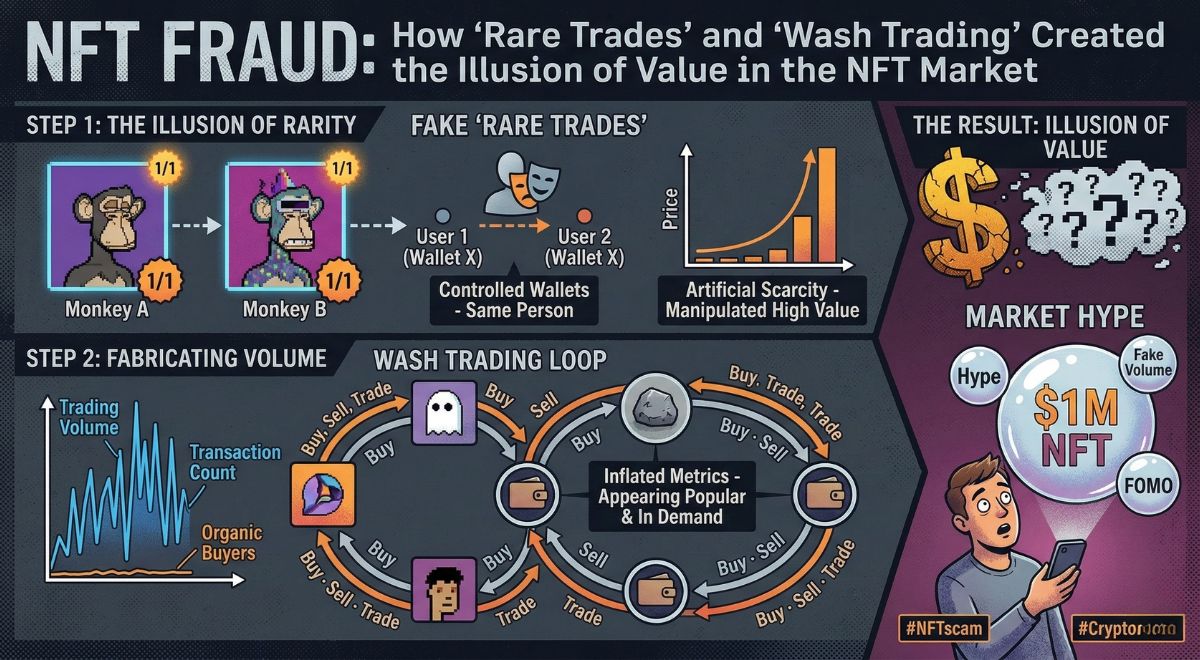
A major form of manipulation in the NFT ecosystem is known as Wash Trading. Wash trading occurs when the same person or group buys and sells the same asset repeatedly using different wallets to create the illusion of demand and rising prices.
Because NFT transactions occur on public blockchains such as Ethereum, traders can easily create multiple anonymous wallets. This allows them to sell an NFT from one wallet to another they control, often at a higher price each time. These fake trades appear on marketplace records and price charts, misleading other investors into believing that a particular NFT collection is rapidly increasing in value.
In some cases, traders conducted hundreds of wash trades within a single project, artificially pushing floor prices higher and attracting new buyers who feared missing out on potential profits.
Rare Trades That Distorted the Market
Another tactic used to inflate NFT valuations involved unusually high “rare trades.” Certain NFTs within a collection were sold for massive sums, sometimes tens of millions of dollars. While these sales grabbed headlines, many were later suspected to be coordinated transactions between wallets controlled by the same individuals.
A famous example occurred on OpenSea and other marketplaces where rare NFTs were sold for extreme prices shortly after launch. These high-value transactions created a perception that the entire collection was valuable, encouraging other buyers to enter the market at inflated prices.
In reality, these rare trades often represented only a small number of manipulated transactions rather than genuine market demand.
Incentives That Encouraged Manipulation
Some NFT platforms unintentionally encouraged wash trading through reward systems. For example, marketplaces that distributed governance tokens or trading rewards based on transaction volume inadvertently motivated users to generate fake trades to earn these incentives.
Platforms like LooksRare and others faced criticism when analysts discovered that a large portion of their trading volume was generated through wash trading. In some cases, more than half of the reported trading activity was estimated to be artificial.
These incentives turned NFT trading into a game where participants could profit simply by trading assets back and forth with themselves.
The Impact on Investors
The manipulation of NFT prices had serious consequences for ordinary investors. Many buyers entered the market believing they were purchasing scarce digital assets with growing demand. However, when the broader crypto market slowed in 2022, NFT prices collapsed across most collections.
Projects that once recorded millions of dollars in daily trading volume saw activity drop dramatically. Many NFTs that sold for thousands or even hundreds of thousands of dollars became nearly impossible to sell at any meaningful price.
This collapse revealed how much of the NFT market had been driven by speculation and artificial trading activity rather than sustainable demand.
Regulatory Attention and Market Changes
As concerns about fraud and manipulation grew, regulators began paying closer attention to the NFT sector. Agencies such as the U.S. Securities and Exchange Commission have investigated whether certain NFTs may qualify as securities and whether market manipulation violated financial regulations.
Meanwhile, blockchain analytics firms have developed tools to detect suspicious trading patterns, making it easier to identify wash trading and coordinated market manipulation.
Some NFT marketplaces have also introduced stricter policies, including monitoring systems designed to flag suspicious wallet activity.
The Future of the NFT Market
Despite the controversies, NFTs are unlikely to disappear entirely. The underlying technology still offers potential applications in gaming, digital identity, and intellectual property management. However, the speculative era of NFTs—where hype and artificial trading drove massive valuations—appears to be fading.
For the NFT market to regain credibility, platforms will need stronger transparency, better safeguards against manipulation, and clearer regulatory frameworks.
The lessons from the NFT boom highlight a broader truth about emerging digital markets: when innovation moves faster than oversight, opportunities for fraud and manipulation often follow.