
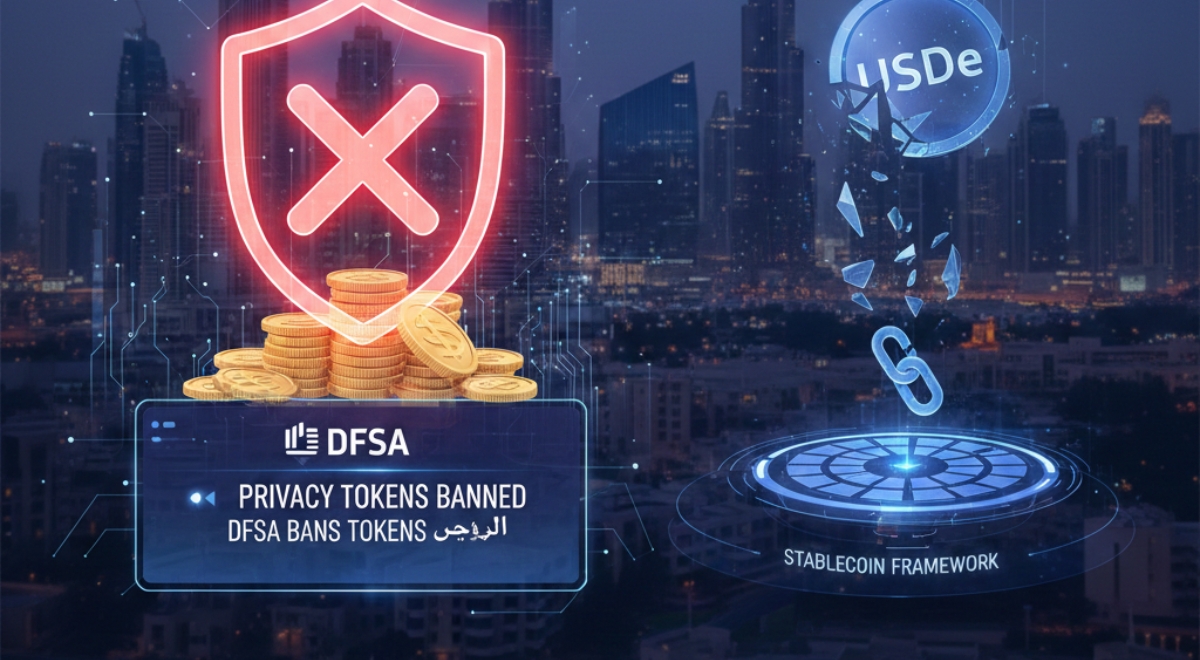
Dubai’s digital asset regulatory landscape has tightened further as the Dubai Financial Services Authority (DFSA) announced a ban on privacy tokens within the Dubai International Financial Centre (DIFC), while clarifying that USDe does not qualify as a regulated stablecoin under its existing framework.
Ban on Privacy Tokens
The DFSA’s updated rules prohibit the use, issuance, and promotion of privacy-focused tokens within the DIFC. Privacy tokens, which are designed to obscure transaction details such as sender, receiver, and amounts, have long raised regulatory concerns due to their potential use in illicit financial activity.
By enforcing this ban, the DFSA aims to strengthen transparency, enhance anti-money laundering (AML) compliance, and align the DIFC with global financial crime prevention standards.
USDe Excluded From Stablecoin Classification
In addition to banning privacy tokens, the DFSA clarified that USDe falls outside the definition of a regulated stablecoin. Unlike traditional stablecoins that are typically backed by fiat reserves or high-quality liquid assets, USDe operates using a synthetic mechanism that does not meet the DFSA’s stablecoin criteria.
As a result, USDe cannot be marketed or treated as a stablecoin within the DIFC’s regulated financial environment, limiting how firms can offer or reference the token under DFSA oversight.
Regulatory Clarity for Crypto Firms
The move provides important clarity for crypto exchanges, custodians, and fintech firms operating in or seeking entry into the DIFC. By clearly defining which digital assets are permitted and how they are classified, the DFSA reduces regulatory ambiguity and sets clear compliance expectations for market participants.
Balancing Innovation and Risk
While the DFSA continues to support innovation in digital assets and blockchain technology, these measures highlight its risk-based regulatory approach. The authority is signaling that innovation must operate within frameworks that prioritize market integrity, transparency, and investor protection.
Implications for Dubai’s Crypto Ecosystem
Dubai remains one of the most progressive jurisdictions for digital asset regulation, but recent actions demonstrate a firm stance on high-risk token structures. Firms operating in the DIFC will need to reassess product offerings, token listings, and compliance strategies to align with the updated rules.