
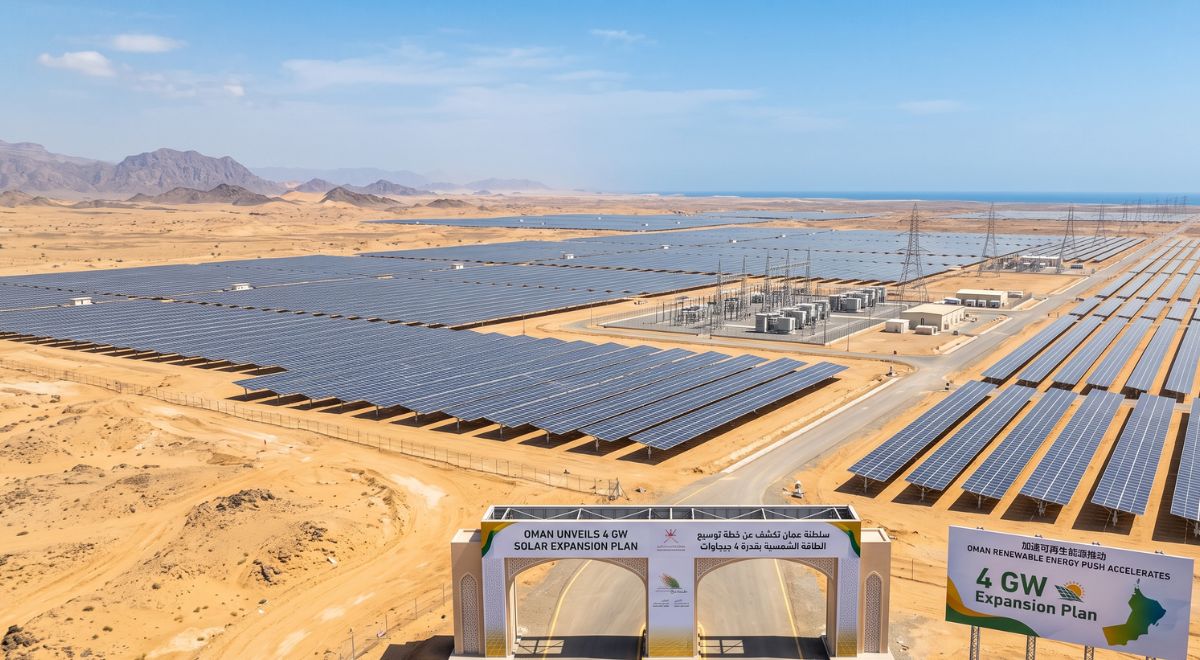
Oman has announced plans to develop four utility-scale 1 GW solar photovoltaic (PV) Independent Power Projects (IPPs) from 2028 onwards, marking a major step in the Sultanate’s strategy to increase renewable energy generation and achieve its target of sourcing at least 30% of electricity from clean energy by 2030.
The projects form part of the Oman Electricity Transmission Company’s (OETC) Five-Year Annual Capability Statement (2026–2030), which outlines the country’s roadmap to diversify its energy mix, reduce reliance on fossil fuels, and strengthen long-term energy security.
The first project, the 1,000 MW Adam Solar IPP in Al Dakhiliyah Governorate, is scheduled to begin commercial operations in 2028 after Nama Power and Water Procurement Company (PWP) launched the Request for Qualifications (RfQ). Three additional 1 GW solar projects are planned from 2029 onward, including Al Kamil Phase II in North Al Sharqiyah, Thamrait in Dhofar, and Mahadha in Al Buraimi.
Before these large-scale developments come online, Oman will add several medium-sized solar projects to the national grid. These include the 500 MW Ibri Solar III, expected in 2027, followed by the 400 MW Al Kamil I Solar IPP, 280 MW Marsa Solar IPP, and 500 MW Sinaw Solar IPP, all targeted for commissioning in 2028.
The Sultanate is also expanding its wind energy portfolio. Projects due for completion in 2028 include the 105 MW JBB Ali Wind Farm, 300 MW Ras Madrakah Wind Farm (Duqm II), 800 MW Mahout Wind IPP, 125 MW Dhofar II Wind IPP at Harweel, and 120 MW Sadah Wind IPP, collectively adding around 1.45 GW of wind generation capacity.
Further wind projects planned beyond 2029 include the 100 MW Al Jazir Wind IPP, 300 MW Duqm III Wind IPP, and 220 MW Shaleem Wind IPP, contributing another 620 MW to Oman’s renewable energy capacity.
According to OETC, the rapid rollout of solar and wind projects is expected to increase the share of installed renewable energy capacity from 13.6% in 2026 to 45% by 2030. The expansion will be supported by significant upgrades to the national transmission network, including additional reserve capacity and enhanced grid flexibility to accommodate intermittent renewable generation.
The ambitious investment programme positions Oman among the Gulf region’s leading renewable energy markets, reinforcing its commitment to modernising the power sector, improving energy resilience, and advancing long-term sustainability objectives.