
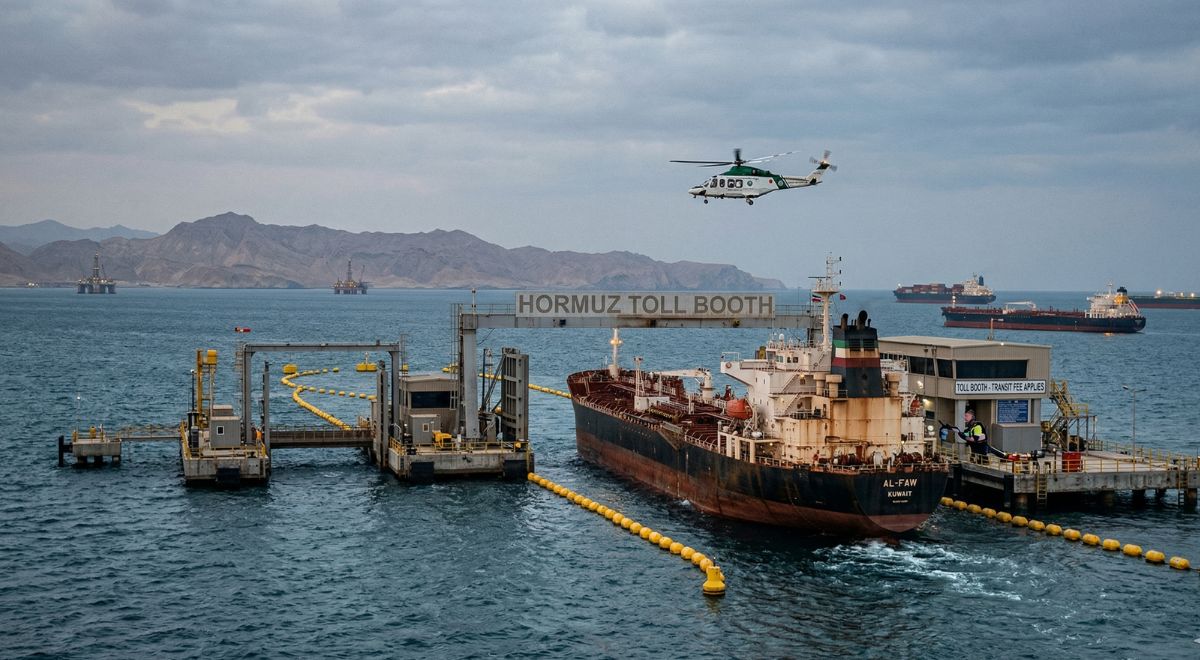
The strategic importance of the Strait of Hormuz has once again come under global scrutiny, as discussions around the idea of imposing a “toll” on vessels passing through the vital shipping lane have triggered strong reactions from Gulf oil producers. For nations whose economies depend heavily on uninterrupted energy exports, any attempt to monetize or restrict access to this narrow maritime corridor is being described as both impractical and unacceptable.
A Lifeline for Global Energy
The Strait of Hormuz is one of the world’s most critical chokepoints, handling roughly a fifth of global oil trade. Major Gulf producers—including Saudi Arabia, the UAE, Kuwait, and Iraq—rely on this route to transport crude oil and liquefied natural gas (LNG) to international markets. Even minor disruptions in the strait can send shockwaves through global energy prices.
The proposal of introducing a toll system—essentially charging vessels for safe passage—raises concerns not only about increased costs but also about the precedent it sets. Gulf producers argue that such a move could undermine the principles of free navigation under international maritime law.
Economic and Political Fallout
Energy-exporting countries in the Gulf have made it clear that any form of “toll booth” in the Strait of Hormuz would be viewed as a direct threat to their economic stability. Increased transit costs would likely be passed on to global consumers, potentially driving up oil prices and fueling inflation in energy-dependent economies worldwide.
Moreover, Gulf officials warn that the idea could escalate geopolitical tensions in an already sensitive region. The strait has long been a focal point of regional rivalries, and any attempt to control or commercialize access could provoke retaliatory measures or military posturing.
Legal and Maritime Concerns
Under international law, particularly the United Nations Convention on the Law of the Sea (UNCLOS), straits used for international navigation are meant to remain open and accessible to all vessels. Gulf producers emphasize that introducing tolls could violate these legal frameworks, creating disputes that extend beyond regional boundaries.
Shipping companies and global energy firms have also expressed unease. The added financial burden, combined with uncertainty over enforcement and security, could disrupt supply chains and discourage investment in the region.
Strategic Alternatives and Preparedness
In response to recurring concerns about the vulnerability of the Strait of Hormuz, some Gulf nations have invested in alternative export routes. Pipelines that bypass the strait—such as those running across Saudi Arabia and the UAE—offer partial solutions, but they cannot fully replace the volume handled by maritime transport.
Still, these efforts highlight a broader strategy: reducing dependence on a single chokepoint while maintaining stability in global energy markets.
A Global Issue, Not Just Regional
The debate over a potential Hormuz toll system is not confined to the Gulf. Major energy consumers in Asia, Europe, and beyond are closely watching developments. Any disruption or additional cost imposed on this route would have immediate and far-reaching consequences for global trade and economic growth.