
The ongoing conflict involving Iran has rapidly evolved into one of the most critical geopolitical crises of the decade. Beyond military tensions, the war has triggered a global energy shock, disrupting oil supply chains, pushing prices higher, and raising fears of prolonged economic instability.
With the Strait of Hormuz—responsible for nearly 20% of global oil shipments—at the center of the crisis, how this war ends will have lasting consequences for energy markets, inflation, and global growth.
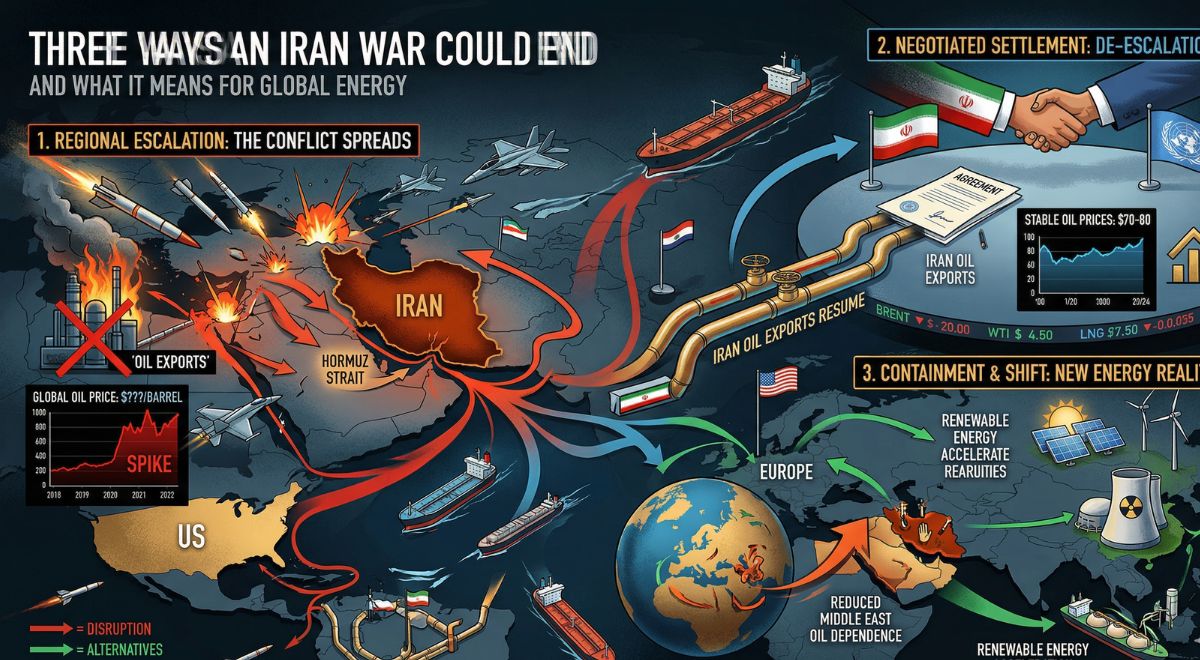
Below are three realistic scenarios for how the Iran war could end—and what each outcome means for global energy.
1. Prolonged Escalation and Regional Conflict
In this scenario, the war intensifies, with continued military strikes, attacks on infrastructure, and prolonged disruption to shipping routes like the Strait of Hormuz.
Iran could retaliate by targeting oil facilities or restricting maritime traffic, while opposing forces increase pressure on key export hubs such as Kharg Island—responsible for most of Iran’s oil exports.
Impact on Global Energy:
- Oil prices surge significantly and remain volatile
- Supply shortages hit Asia and Europe the hardest
- Inflation rises globally due to higher fuel and transport costs
- Alternative producers (Africa, U.S., Brazil) benefit from higher demand
Recent reports already show oil prices jumping sharply due to supply disruptions and shipping blockages.
This is the worst-case scenario for global markets, potentially leading to stagflation—a combination of high inflation and slow economic growth.
2. Partial Withdrawal or “Walk Away” Strategy
In this outcome, major powers reduce direct involvement, leaving the region unstable but avoiding full-scale escalation. Iran retains influence over key waterways, and global powers shift focus elsewhere.
While this may reduce immediate military tensions, it creates long-term uncertainty in energy markets.
Impact on Global Energy:
- Oil prices remain elevated due to persistent risk
- Shipping routes become politically unstable
- Global energy markets factor in a permanent “risk premium”
- Countries accelerate energy independence strategies
This scenario could also weaken international trade norms, with strategic chokepoints like Hormuz becoming politicized.
The result: a fragile global energy system where uncertainty becomes the new normal.
3. Negotiated Settlement or Conditional Armistice
The most stable outcome would involve diplomacy—leading to a ceasefire or agreement that reopens key oil routes and restores energy flows.
This could include easing sanctions, restoring exports, and ensuring freedom of navigation through the Strait of Hormuz.
Impact on Global Energy:
- Oil prices stabilize or decline
- Supply chains normalize over time
- Inflation pressures ease globally
- Investor confidence returns to energy markets
Even in this best-case scenario, the effects of the war may linger. Analysts warn that energy disruptions can continue impacting markets for months after hostilities end.
Why This War Matters for Global Energy
The Iran conflict has exposed how dependent the world still is on fossil fuels and vulnerable supply routes. Recent developments—including price spikes and supply shortages across Asia—highlight how quickly disruptions can ripple across industries.
At the same time, rising energy prices are fueling inflation concerns globally, with financial leaders warning of long-term economic consequences.